Introduction
If you’re deciding between a photography certificate, diploma, or advanced diploma in Mumbai, the right choice depends on your experience level, career goal, time commitment, and desired specialization. Each course answers a different question at a different stage of your journey, and picking the wrong one can cost you time and money you didn’t need to spend.
Visual content has taken over the internet, and few cities feel that shift as directly as Mumbai. The city is home to the India headquarters of major global advertising networks and is widely known as the country’s advertising and film capital, which creates a substantial market for photographers and videographers with strong technical and creative skills. This has helped turn photography from a hobby into a genuine career path in the city, one that offers creative freedom, flexible work options, and real earning potential for those who build the right skills.
Most institutes list modules and durations but rarely explain what you’ll actually be qualified to do once you finish or how one course connects to the next. Add in mixed advice from social media and photographers who took entirely different routes, and it’s easy to feel stuck before you’ve even picked up a camera. This guide breaks it all down so you can choose with confidence.
1. The Real Dilemma: Certificate vs. Diploma vs. Advanced Diploma
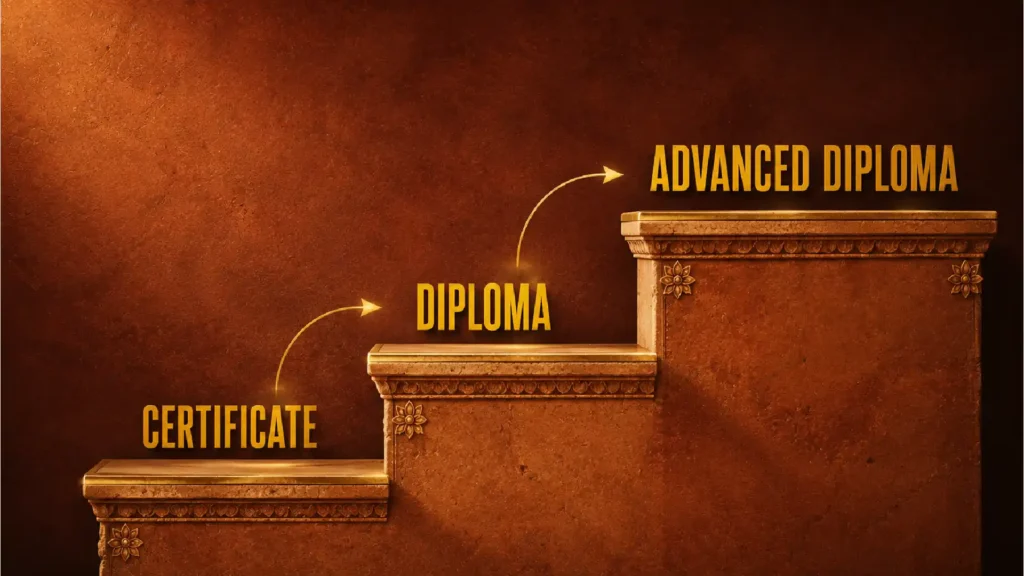
Many photography institutes offer some version of these three course types, but they’re not interchangeable. They differ in duration, depth, cost, and, most importantly, the kind of career they prepare you for. This matters in a market like Mumbai, where photography courses feed into commercial photography, fashion photography, wedding photography, and advertising and content production work happening right in the city.
Think of it as a ladder: each level builds on the one before it, offering more specialization and more industry readiness. The right rung for you depends on where you’re starting from and where you want to end up. The confusion usually comes from treating these as competing options rather than connected stages: a certificate isn’t a lesser diploma, and a diploma isn’t just a longer certificate.
It’s also worth knowing that course names aren’t standardized across institutes. One school’s “advanced diploma” may cover what another calls a “professional diploma,” so it’s worth comparing the actual syllabus and outcomes rather than the title alone.
2. What Is a Certificate Course in Photography?
- Duration: Typically 6 months
- Curriculum: Camera fundamentals, including exposure, composition, lighting basics, manual mode, and introductory editing (Lightroom/Photoshop)
- Who it’s for: Complete beginners, hobbyists who want to go pro, or working professionals looking to add a creative skill without a long-term commitment
A certificate course is the fastest way to go from “I own a camera” to “I actually know how to use it.” It won’t make you a specialist, but it gives you the foundation every photographer needs before branching into a specific genre.
Most certificate programs are built around short, hands-on modules, so you’re shooting from week one rather than sitting through months of theory. Because the course is compact, it fits well alongside a job or college, which is why it attracts such a mixed group: some are testing whether photography is right for them, others are adding a creative skill to an existing career.
3. What Is a Diploma in Photography?
- Duration: Typically 1 year
- Curriculum: Builds on certificate-level basics with deeper technical training and genre specialization, such as commercial, wedding, fashion, or product photography, plus more structured portfolio work
- Who it’s for: Students straight out of 10th or 12th grade, or career-switchers serious about photography as a full-time profession
A diploma gives you real depth. You’re not just learning how a camera works; you’re learning how to work as a photographer, with assignments, critiques, and a body of work you can show clients or employers.
Over a full year, you have room to actually specialize instead of skimming every genre. Diploma programs often simulate real client work (shoot briefs, deadlines, and revisions), so students leave with workflow habits and a genre-specific portfolio, in addition to technical skill.
4. What Is an Advanced/Professional Diploma in Photography?
- Duration: Typically 2 to 3 years
- Curriculum: Everything in a diploma, plus advanced specializations such as cinematic videography, media business fundamentals, brand strategy, and extended portfolio and showreel development
- Who it’s for: Students who want broader industry readiness: not just as a photographer, but as someone equipped to run a studio, lead a shoot, or freelance at a more advanced level
This is the most comprehensive of the three routes. The additional time is generally used to cover ground a diploma doesn’t: leading a shoot from concept to delivery, the basics of managing clients and budgets, and working across both stills and video, since a growing share of commercial and brand work involves both. Many programs at this level have students build a showreel alongside a photography portfolio.
Course names and durations vary between institutes, so it’s worth comparing the actual curriculum, practical training, portfolio requirements, and industry exposure rather than judging a program by its title alone. An advanced diploma is a bigger commitment of time and money, so it makes more sense for students who are already fairly confident photography is the career they want, rather than as a default first step.
5. Side-by-Side Comparison
| Certificate | Diploma | Advanced/Professional Diploma | |
| Duration | About 6 months | About 1 year | 2 to 3 years |
| Depth | Foundational | Specialized | Industry-ready |
| Best for | Beginners, hobbyists | Career-focused students | Long-term professionals |
| Portfolio | Basic projects | Genre-specific portfolio | Full professional portfolio and showreel |
| Career readiness | Entry-level, assistant roles | Junior photographer, freelancer | Studio-ready, business-ready |
6. Career Outcomes After a Certificate Course
A certificate is a good launchpad, not a finish line. Graduates typically move into:
- Assistant photographer roles
- Freelance work in social media or events on a small scale
- A stepping stone into a diploma program once they’ve confirmed photography is the right path
These early roles matter more than they seem. Assisting an established photographer exposes you to client interactions and shoot logistics that are hard to learn in a classroom, while small freelance gigs build the first entries in your portfolio. Many certificate graduates use this stage to test which genre interests them before deciding whether a diploma is worth the extra year and cost.
7. Career Outcomes After a Diploma
With a diploma, you’re typically stepping into more defined, paid roles:
- Junior or specialized photographer (wedding, product, fashion)
- Studio photographer
- Independent freelancer with a genre-specific portfolio
- Photo editor or content creator roles at agencies and brands
The shift from certificate to diploma outcomes is broadly a shift from “hired to help” to “hired to deliver.” Studios are more likely to bring on diploma graduates for roles needing less supervision, and freelance clients at this level tend to expect a portfolio with a clear style rather than a general sampler. For many graduates, this is also the stage where photographers start setting formal rates and where photography can become a bigger part of their income, though how quickly that happens still depends heavily on individual hustle, niche, and local demand.
8. Career Outcomes After an Advanced/Professional Diploma
An advanced diploma can open doors to higher-responsibility work, including:
- Lead photographer or videographer roles at agencies and studios
- Commercial and brand photography contracts
- Running your own photography or content studio
- Cinematic videography and brand film projects
Mumbai’s concentration of ad agencies, production houses, fashion events, and film and OTT work gives graduates a sizeable local market to pitch into. The city is home to India offices of major global advertising networks, including WPP,1 and is widely recognized as the base of Hindi-language cinema (Bollywood), one of the largest film industries in the world by number of films produced.2 It also hosts Lakmé Fashion Week X FDCI, one of India’s leading fashion events, held twice a year at the Jio World Convention Centre.3
At this stage, the nature of the work often shifts: instead of only executing someone else’s brief, advanced diploma graduates may find themselves writing the brief, coordinating with junior photographers, or handling client and budget conversations directly. The business training included at this level is meant to support exactly that kind of work, though turning it into a sustainable studio or steady contract flow still comes down largely to individual skill, portfolio, and network.
That said, course level is only one part of the equation. Strong outcomes tend to come from combining the right course with a solid portfolio, hands-on practical experience, a clear specialization, and active networking, rather than the qualification alone. Actual earnings and opportunities depend more on skill, niche, and client base than on any certificate or diploma by itself
9. How to Choose the Right Path Based on Your Goals
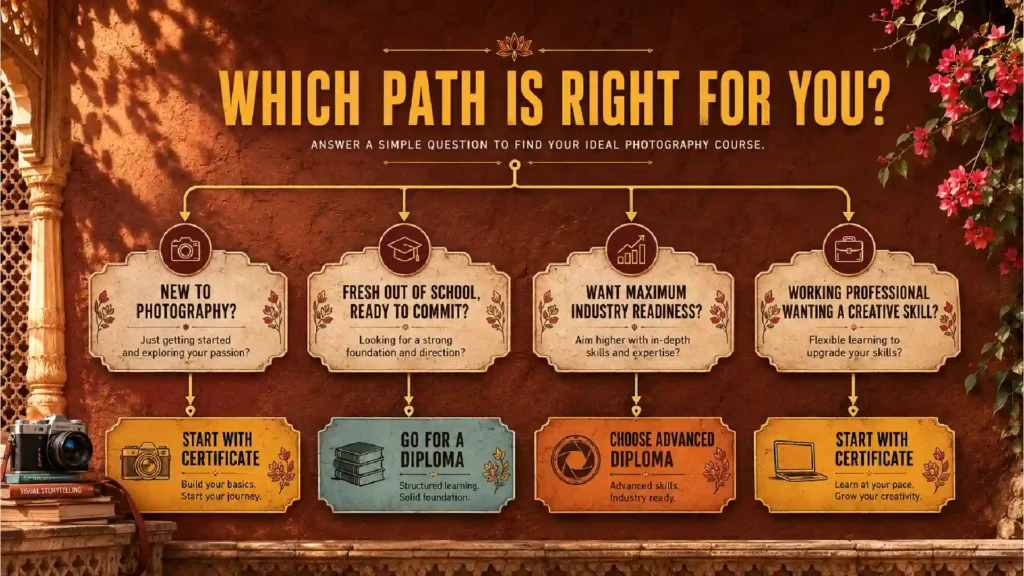
- Just curious if photography’s for you? Start with a certificate.
- Fresh out of school and ready to commit? Go straight for a diploma.
- Already sure this is your career and want broader industry readiness? The advanced/professional diploma may be worth the extra time, particularly if you want to lead shoots, run a studio, or work across both stills and video.
- Working professional wanting a creative side skill? A certificate fits around your schedule without derailing your career.
There’s no universally “right” answer, only the right answer for where you are right now. It helps to think honestly about two things: how much time you can realistically commit and how far along you already are in figuring out what kind of photography interests you. Someone who’s already shot weddings for friends and knows their genre may be better served jumping straight into a diploma, while a complete beginner may benefit from building confidence first.
FAQs
Yes. A certificate isn’t a prerequisite; it’s simply a shorter, lower-commitment option for beginners. If you’re already sure about pursuing photography seriously, you can enroll directly in a diploma program.
Generally, diploma and advanced diploma holders command higher pay due to specialized skills and stronger portfolios, but actual earnings depend more on skill, niche, and client base than the certificate alone.
It can be for smaller or beginner-level freelance work like social media content or small events. For consistent, higher-paying freelance work, a diploma-level skill set is usually more competitive.
Most certificate and diploma programs accept students who’ve completed 10th grade, though specific requirements vary by institute and course level.
Some students start freelancing in small ways during or right after a certificate course. There’s no fixed timeline to a stable income, it depends heavily on effort, specialization, and networking, but a diploma-level skill set combined with a strong portfolio tends to shorten the path.
Conclusion
Choosing between a certificate, diploma, and advanced diploma isn’t about picking the “best” one. It’s about picking the one that matches your goals, timeline, and how serious you are about turning photography into a career. Start where you’re comfortable, and let your next course build on what you’ve already learned.
Ready to take the first step? Explore Le Mark Institute’s Photography & Digital Film Making courses, from the Professional Certificate to the Professional Diploma in Photography, and find the path that unlocks your career. You can also browse all photography courses at Le Mark to compare durations, specializations, and campuses before you enroll.