
Introduction
The wedding film that made you tear up. The brand ad that stopped your scroll mid-feed. The travel reel that had you checking flight prices before the video even ended. Someone shot all of it on a schedule, with a plan, and often on a budget smaller than you’d guess. Videography has become one of the more accessible, in-demand creative skills in India, and the entry point is lower than most people assume.
What makes it especially appealing right now is how little stands between curiosity and a first real shoot. You don’t need a film school degree or expensive equipment to start; a smartphone and a willingness to shoot, fail, and reshoot are often enough to begin building real skill.
What separates hobbyists from working professionals isn’t access, it’s how deliberately they practice. The rest of this guide is meant to shorten that gap, turning scattered curiosity into a clear, workable starting point. Whether you’re picking up a camera for the first time or trying to turn an existing hobby into paid work, the fundamentals ahead apply either way.
1. What Does a Videographer Actually Do?
The day-to-day depends heavily on the niche: a wedding videographer shoots emotional, unscripted moments over long hours; a brand videographer works from a short list and client brief; a content creator might shoot, edit, and post all in one afternoon.
The job usually starts before the camera turns on: understanding the client’s goals, scouting locations, and planning shots. Raw footage rarely tells a story on its own; editing and pacing shape it into something worth watching. What’s common across every niche: composition, camera settings, lighting, and storytelling through movement.
The work also doesn’t end when editing wraps. Exporting in the right format for the platform it’s headed to, backing up raw footage, and sending files to the client all take real time that beginners rarely budget for. And no two shoot days look alike: weather changes a location shoot’s whole plan, a couple runs late at a wedding, or a brand’s brief shifts mid-shoot. Adapting on the spot, while still capturing what the story actually needs, is a skill in itself, separate from knowing how to operate a camera.
2. Skills You Need to Build Before You Start
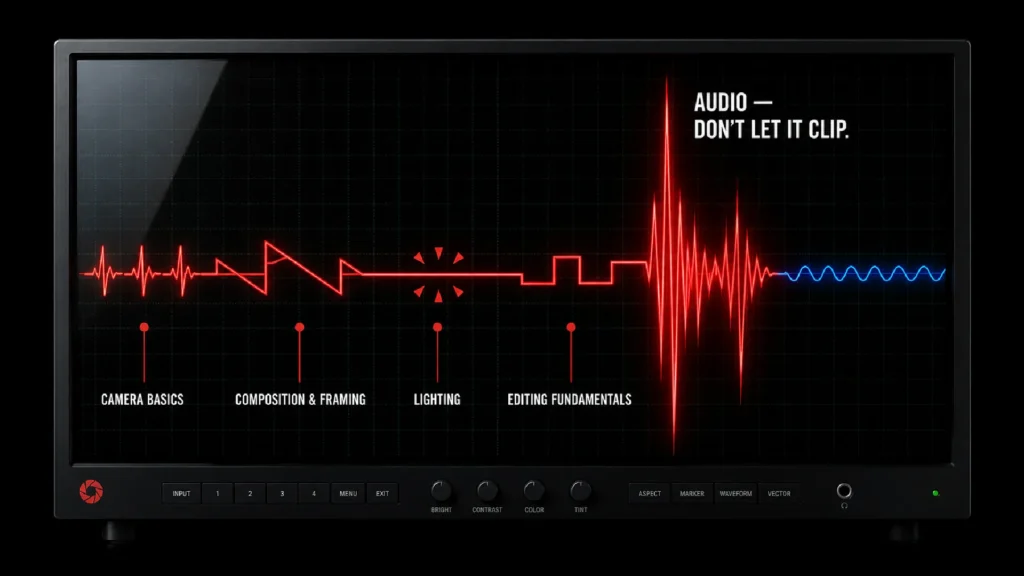
- Camera basics: exposure, shutter speed, aperture, ISO, manual mode
- Composition and framing: rule of thirds, movement within frame, leading lines
- Basic lighting: natural light control, three-point lighting for interviews
- Editing fundamentals: cutting on action, pacing, color correction
Audio deserves special attention. Beginners often underinvest here, and viewers forgive average visuals more readily than bad sound. George Lucas summed up why this matters, telling Mix magazine in a career interview (a quote he first gave to The New York Times in 1992): “Sound is half the experience.” Get familiar with lavalier and shotgun microphones, keeping recording levels from clipping, checking a location for background noise, monitoring with headphones while shooting rather than only afterward, and capturing a few seconds of room tone for editing.
3. Business and Client Skills You’ll Need
Technical skill gets you hired once. Business skills keep you working:
- Quoting and pricing based on project scope, not guesswork
- Contracts and briefs, even informal ones, covering deliverables and revision limits
- Client communication, especially around turnaround time and what counts as “final”
- Invoicing and the basics of GST, once you’re freelancing seriously
- Usage rights, being clear on whether a client can reuse or resell your footage
Skipping this is a common reason skilled beginners struggle to turn videography into reliable income. Many first-time freelancers also underestimate how much time client management itself takes: chasing feedback, managing scope creep when a client asks for “just one more version,” and setting boundaries around response times. Treating these as real business tasks, not afterthoughts, is often what determines whether a client rebooks you.
4. Learn to Tell Stories, Not Just Shoot Videos
Picking up camera-to-editing mechanics is the fast part. Understanding what you want the viewer to feel takes longer, and that’s the real gap between footage and a film. Worth learning early: structure (a beginning, middle, and end, even in a 30-second reel), establishing shots, close-ups that carry emotion, B-roll, continuity, pacing, sound design, and the one or two moments in a piece that should land hardest.
Technical skill without narrative sense produces videos that are technically fine but forgettable. Oscar-winning cinematographer Roger Deakins put it plainly: “The most important thing is the story.” A useful habit here is watching films and ads you admire specifically for structure, not just visuals, pausing to ask why a cut happens where it does or why a shot lingers a beat longer than expected.
That kind of deliberate viewing trains instincts that tutorials alone rarely teach, and it costs nothing but attention and a bit of patience.
5. Understanding the Gear: What a Beginner Actually Needs
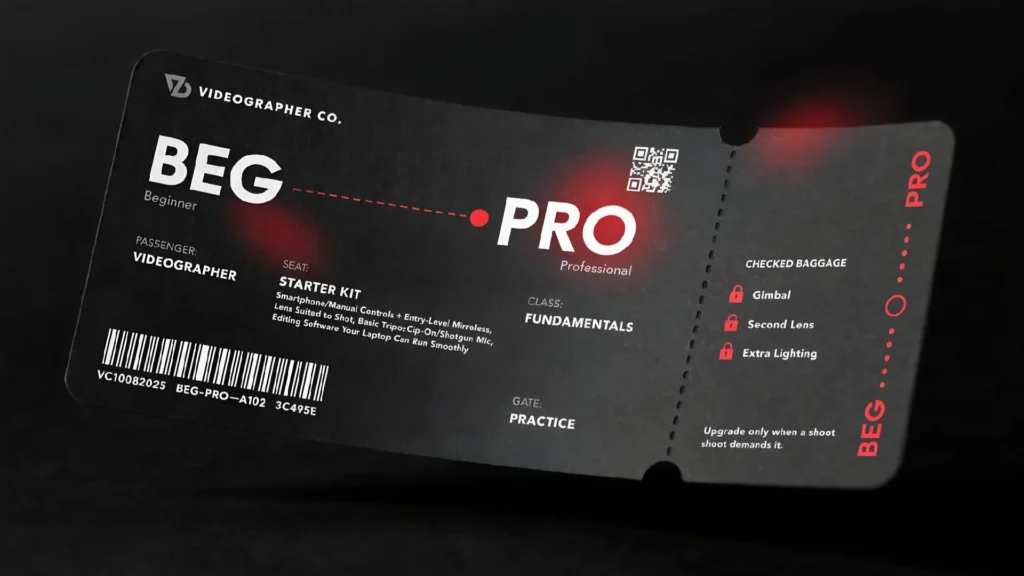
Most beginners build skill on a smartphone or an entry-level mirrorless camera and then upgrade as projects demand it. A realistic starting kit: a smartphone with manual controls or an entry-level mirrorless camera, a lens suited to what you’re shooting, a basic tripod for stability, a clip-on or shotgun mic, and editing software your laptop or phone can run smoothly.
Buy the next piece of gear (a gimbal, a second lens, or extra lighting) once a specific shoot proves you need it, not because it’s what other videographers use. It also helps to rent before you buy anything expensive or occasion-specific, like a drone, a cinema-grade lens, or professional lighting kits, so you learn whether a tool genuinely improves your work before committing the budget to owning it outright.
Storage and backup gear matter more than most beginners expect too: a couple of reliable memory cards and an external hard drive can protect you from one of the worst mistakes a videographer can make, losing a client’s footage. Budget for this before the next lens upgrade, not after.
6. Certificate vs. Diploma: Where Formal Training Fits In
Self-learning through tutorials and trial and error works; plenty of professionals started that way. But gaps tend to surface later, in lighting, pacing, or working confidently under a client brief.
The practical difference between a certificate and a diploma comes down to depth and time. A certificate course (typically a few months) suits a focused introduction to camera fundamentals, composition, and basic editing. A diploma generally involves a longer, more comprehensive period of study, with deeper cinematography, directing, and genre-specific training.
Neither is required, but structured education can accelerate the early learning curve through guided practice and feedback. Institutes like Le Mark Institute offer both a certificate course and a diploma in photography and digital filmmaking for anyone who’d rather follow a curriculum than guess what’s next.
7. Your First 30 Days: A Starter Roadmap
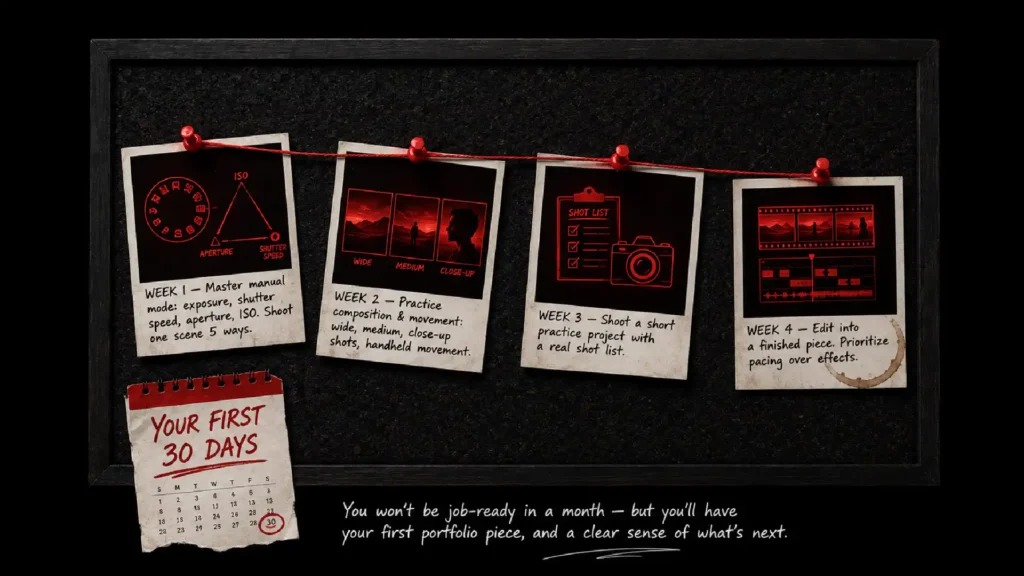
- Week 1: Master manual mode: exposure, shutter speed, aperture, ISO. Shoot one scene five different ways.
- Week 2: Practice composition and movement: wide, medium, and close-up shots, basic handheld movement.
- Week 3: Shoot a short practice project (a friend’s event or a mock brand video) with a real shot list.
- Week 4: Edit it into a finished piece, prioritizing pacing over effects.
You won’t be job-ready in a month, but you’ll have your first portfolio piece and a clearer sense of what to learn next. Treat this as a repeatable cycle: run it again the following month with a slightly harder project. Each pass tends to surface a different weak spot, clean audio but dragging pacing, or sharp shots but no clear ending, and fixing one gap at a time compounds faster than trying to improve everything at once.
8. Building Your First Portfolio Project
Clients and studios generally need to see demonstrated work, not just potential. Your first project doesn’t need to be perfect; it needs to show you can plan a shoot, execute it, and edit it into something coherent. Good starter ideas: a short documentary-style piece on someone you know, a mock brand video for a local business, a friend’s small event, or a personal passion project. The goal isn’t perfection. It’s proof of process.
Once you have two or three of these pieces, curate ruthlessly: three strong, varied pieces that show range across composition, storytelling, and editing will do more for you than ten mediocre ones that all look similar. Update the portfolio every few months, retiring the earliest pieces once stronger work replaces them.
It also helps to think about your portfolio the way a client will actually watch it: on a phone, often skipping ahead within the first ten seconds. Lead with your strongest shot rather than easing in slowly, and keep the reel short enough that a client scrolling through several videographers’ work doesn’t lose patience with yours first.
9. Finding Your Niche: Weddings, Brands, Content, or Films
Videography isn’t one career. It’s several, loosely connected by a camera. In India, wedding and event videography is often where beginners find their first paid, referral-driven work. Other paths: commercial and brand videography, content creation for YouTube or Instagram (regional-language content included), documentary and film, and corporate videography. Many videographers try several niches before settling into the one that fits them best.
It’s worth trying more than one niche early on rather than committing prematurely, since the day-to-day realities differ more than they appear from the outside. Wedding work means long, unpredictable hours and heavy emotional pressure; brand work means tighter briefs and client approvals; content creation means faster turnarounds and a more personal on-camera presence. What looks appealing in theory doesn’t always match what you enjoy shooting week after week, and only doing the work reveals that.
Money shouldn’t be the only factor either. A niche that pays well but drains you emotionally, like weddings are a common example, rarely sustains a long career the way a slightly less lucrative but genuinely enjoyable niche does, especially once you’re relying on it full-time.
10. Freelancing vs. Studio vs. Agency: Which Path Fits You?
- Choose freelancing if creative control matters most and you can handle inconsistent income while managing the business side.
- Choose studio or agency work if you want more predictable income and mentorship over creative autonomy early on.
- Choose an in-house corporate role if stability matters most, even at the cost of creative variety.
Many videographers start with studio or agency work to build contacts, then move into freelancing once they have a name and network. This progression isn’t mandatory, but it does reduce risk: you get paid consistently while learning how shoots, clients, and deadlines actually work under someone else’s supervision before you’re the one responsible for chasing invoices and filling your own calendar.
Switching paths later is also common; plenty of freelancers eventually take an in-house role for stability, and plenty of employed videographers leave to freelance once they’ve built enough of a reputation and client base to sustain it.
There’s also a hybrid option worth considering: many videographers keep a stable studio or in-house role while freelancing selectively on weekends or during slower periods, using that extra work to build a portfolio and client base before making a full transition.
11. Common Mistakes Beginners Make
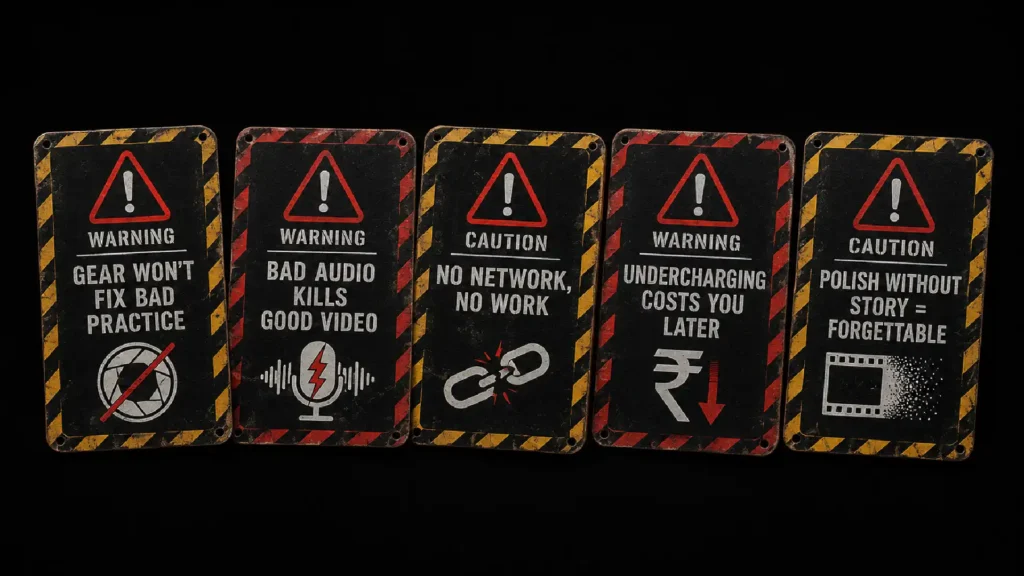
- Chasing gear upgrades instead of shooting more, since a new lens rarely fixes what practice would.
- Skipping audio, which viewers notice faster than mediocre visuals.
- Not networking, since referrals and word of mouth often carry as much weight as cold applications.
- Undercharging out of fear, which makes it harder to raise rates later.
- Ignoring storytelling in favor of pure technical polish.
A less obvious mistake is inconsistent output: shooting intensely for a month, then going quiet for two, which makes it hard to build momentum or a recognizable body of work. Beginners also tend to say yes to every project regardless of fit, diluting their portfolio and making it harder for potential clients to tell what they actually specialize in. Being selective, even early on, usually pays off more than volume alone.
12. How Long It Really Takes to Get Job-Ready
- Learning fundamentals: 3-6 months of focused practice or a certificate course.
- Building a strong portfolio: 6-12 months of active shooting and editing.
- Developing professional-level skills: 1-3 years of sustained shooting, editing, feedback, and real-world experience; a diploma or other structured training can help accelerate that process.
- Building a stable client base: varies considerably by niche, location, and how actively you network.
Finishing a course doesn’t automatically make someone industry-ready; it mainly gives beginners a more organized path through the fundamentals stage than learning entirely from scratch. It’s also worth resisting the urge to compare your timeline to someone else’s highlight reel online. Two videographers who started the same month can be at very different points a year later, depending on how much they actually shot, not just how much they learned in theory, so the more useful benchmark is your own progress from one month to the next.
FAQ
No, many successful videographers are self-taught. But structured training can shorten the learning curve and often provides better networking and placement support.
An entry-level mirrorless camera or a smartphone with solid manual controls. Skill matters more than gear at the beginning.
Yes, many creators build strong portfolios on smartphones before upgrading. Composition, lighting, and storytelling matter more than the device.
Published salary estimates vary widely across sources, and freelance income depends heavily on niche and client type. As a rough 2026 benchmark, industry pay guides put junior freelance video retainers in the range of roughly ₹15,000 to ₹28,000 a month, rising with experience and specialization. It’s more useful to know what drives earnings beyond that number: city, niche, whether you’re freelance or salaried, project complexity, and portfolio strength.
It can be, especially with consistent skill-building and networking. Like most creative fields, income tends to be inconsistent early on and stabilizes as you build a reputation and client base.
Conclusion
Progress comes from showing up consistently, not a single breakthrough. A common path looks something like this: a few months learning fundamentals, a year or so building a portfolio, a gradual shift into paid assistant or freelance work, and eventually a chosen niche with a more dependable client base. Almost every working professional once stood exactly where you are now and worked through some version of it, one shoot at a time.
If you’d rather not figure it out alone, Le Mark Institute’s Photography & Digital Film Making programs are built around this progression, from a foundational certificate course to an advanced diploma in photography and cinematic videography.