
Introduction
Ask most people what a graphic designer does, and they will probably say, “They make things look nice.” That’s not entirely wrong, but it barely scratches the surface. It’s like saying a filmmaker’s job is simply to point a camera. The reality is far more complex and impactful.
Graphic design is the art of visual communication. It explains why you instantly trust a brand after seeing its logo. It’s why a billboard catches your attention during a busy commute. It’s also the reason an app feels intuitive, a product stands out on a shelf, or a movie poster makes you want to watch the film.
Graphic design is not just about making things look attractive. It’s about helping people understand, feel, and take action.
In 2026, India’s digital economy is growing at an incredible pace. At the same time, brands are competing harder than ever for consumer attention. As a result, graphic design has become one of the most in-demand creative skills.
Whether you’re a student deciding what to study after 12th grade or a parent exploring career options for your child, graphic design deserves serious consideration.
1. Every Brand in the World Needs a Graphic Designer
Not some brands. All brands.
From a local chai shop with a social media presence to a multinational launching a product in 40 countries, if a brand needs to communicate visually, it needs to rely on somebody who is proficient in the principles of visual hierarchy, typography, color theory, and branding identity design. A graphic designer, that is.
Think about the things you see every day:
- The app on your phone, its design neat and icon memorable
- The packaging for the snack you mindlessly picked up
- The Instagram reel that arrested you in your scroll to make you click ‘follow’
- The billboard on Western Express Highway that seized your attention at 80 kph
All these instances are designed, mindfully and strategically, by a creatively trained professional. As the Indian startup industry boom and the D2C universe continues to
expand, and the OTT space keeps launching new services, there’s not likely to be a slump in this need; quite the opposite, actually.
2. Graphic Design Is the Foundation of Every Creative Field
Here is a surprising reality that almost every student encounters upon entering the professional world: graphic design isn’t just a single career field but is actually the foundation upon which many other creative fields are built.
- The fashion designer uses communication through visuals to structure their lookbooks, showcase their collection, and develop brand identity for their brand.
- The filmmaker uses design thinking for title sequences, motion graphics, poster layout, and thumbnail strategy for OTT platforms.
- The interior designer uses layout, color theory, and typography every time they develop an idea to be presented to their clients.
- The animator will begin by sketching storyboards, developing character designs, and designing style guides; these initial stages heavily rely on design thinking.
Therefore, by receiving the right instruction in graphic design principles of layout, grid systems, color psychology, and visual communication, students don’t prepare themselves for a singular job. Instead, they develop a broad creative foundation that transfers across industries, creating opportunities that they never anticipated.
3. The Career Paths Are More Diverse Than You Think
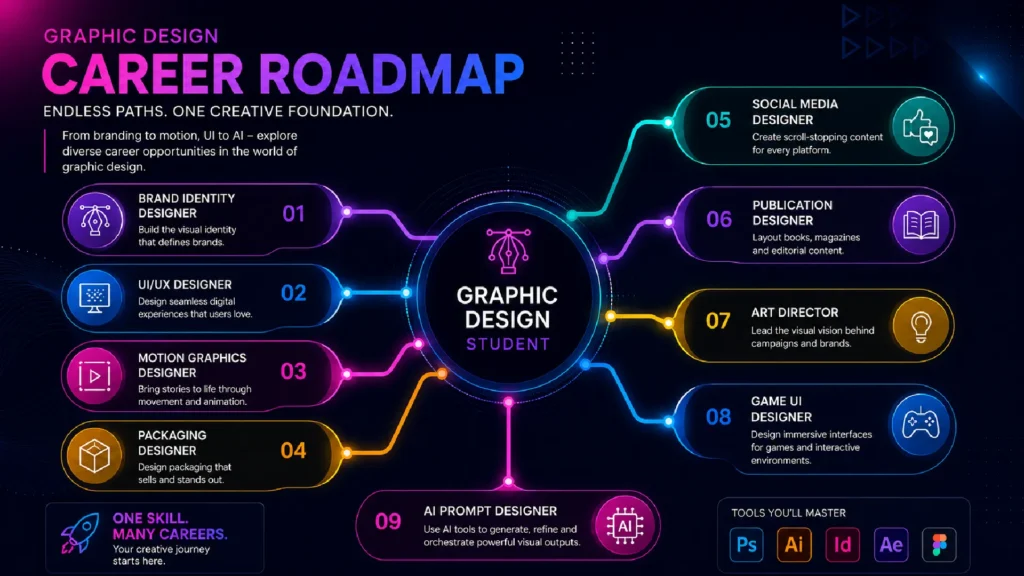
So many students think graphic design = logos. The reality is that much more is possible. Here are some of the graphic design jobs that a graphic design degree can open the door for you to explore:
- Brand Identity Designer – establishing the visual soul of companies’ logos, color palettes, typography systems, and brand guidelines.
- UI/UX Designer – designing the interface for your apps and websites (this is one of the top-paying design roles in India currently!).
- Motion Graphics Designer – creating all kinds of animations for OTT platforms, YouTube, adverts, and brand films.
- Packaging Designer – crafting the packaging of products that help them fly off the shelves (massive demand for this across the Indian FMCG and D2C space!).
- Social Media Designer – designing the entire visual content strategy for brands on Instagram, YouTube, and LinkedIn.
- Publication Designer – laying out magazines, books, and digital editorial content.
- Art Director – overseeing the entire visual direction for a campaign, film, or brand communication.
- Game UI Designer – the go-to person for all things visual interface and environments for the ever-growing gaming sector in India.
One more exciting option growing rapidly:
- AI Prompt Designer – leveraging tools like Midjourney & Adobe Firefly to generate and orchestrate visuals at a massive scale. laying
This isn’t a single job; this is an entire industry of jobs that can be accessed with the same foundational education.
Courses like B.A. in Visual Communication & Animation for 3 years can help students archive these careers
4. India’s Visual Economy Is Growing Faster Than Most People Realise
You just cannot afford to ignore these numbers:
- India’s advertising market will touch 2.01 lakh crore by 2026, and digital is set to account for 68 percent of the total ad spend. The majority of that digital will be in visual form, per Storyboard18
- India already has more than 900 million internet users and the maximum time they spend online is on almost solely visual content, per Expert Market Research-India Digital Marketing Report
- India’s creative economy has now become a $30 billion industry, accounting for 2.5 percent of the GDP and 8 percent of employment, per Ashwini Vaishnav, union minister
- Adobe CEO Shantanu Narayen, speaking at the government-hosted WAVES Summit in Mumbai, said plainly: “India’s next growth as an economy won’t be in software code; it will be in creativity.”
It becomes all the more pertinent when it comes to students in Mumbai. Mumbai is where the brief is written, where the campaign is made, and where the job is acquired. The opportunity is not in some faraway city or faraway land. It is here, right here.
5. A Graphic Design Career Can Take You Anywhere Literally
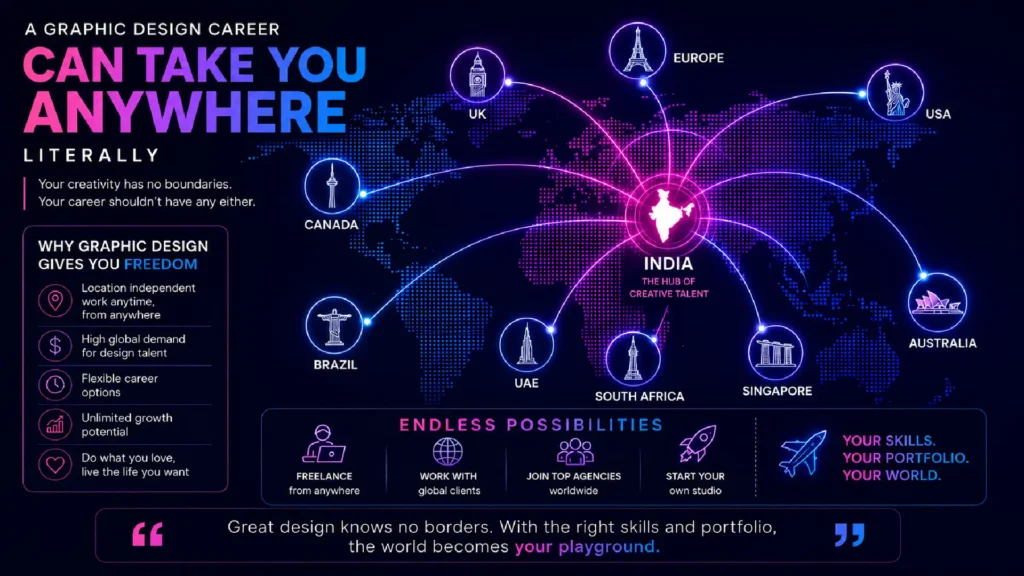
Few creative disciplines can boast of the transferability of graphic design. Once your portfolio is up to scratch and you can communicate at a professional standard using visual language, then the city you inhabit will no longer determine the highest point of your career.
- Freelance abroad from your Mumbai apartment – many Indians get paid dollars and euros for their work through their laptops.
- Set up shop abroad – graphic design services are in high demand in the UAE, United Kingdom, Canada, Australia, and all across Southeast Asia.
- Go the agency route or in-house – the many large and small production studios and advertising agencies of Mumbai, but also any number of firms worldwide.
- Start a studio of your own – with proper training and a laptop, you can run a business in graphic design relatively easily, more easily than many other creative services.
That freedom of being a freelancer, full-time, remote, and self-employed is the type of lifestyle you get, which is what makes graphic design an incredibly secure creative career path for a student. With the visual arts there will always be a market for your services, irrespective of how the economic situation pans out.
Frequently Asked Questions:
Yes, its demand is rising fast in startups, digital media, advertising, and entertainment.
Visual communication in the form of logos, packaging, social media creatives, UI/UX, motion graphics, brand identities, and more.
Typography, color theory, layout, visual hierarchy, graphic design tools like Adobe Illustrator, Photoshop, InDesign, and so on.
Yes, diplomas and degrees in graphic design are available after 12th grade; no design experience is needed to apply for graphic design courses.
A graphic designer’s salary can range from 2.5 to 4.5 LPA for a fresher. Experienced designers in a specialized niche such as UI/UX or motion graphics can earn anywhere between 8 to 18 LPA or even more.
Graphic design is related to overall visual communication, while UI/UX is more focused on user interface for digital products. Graphic designers often transition to UI/UX designers as they progress.
Conclusion
Graphic design is more than a talent. It is a career that sits at the intersection of art, business, technology, and culture. In today’s visual-first world, brands, products, and digital platforms must communicate effectively. As a result, skilled graphic designers will continue to be in demand.
At Le Mark Institute, students learn graphic design through an industry-focused approach. With over 23 years of experience in design and media education, the institute combines creative training with practical exposure. Students work on studio projects and real-world briefs and receive guidance from industry professionals.
The curriculum goes beyond software training. It also develops business awareness, problem-solving skills, and professional experience through live projects. With campuses in Andheri, Ghatkopar, Thane, and Matunga, Le Mark’s programs are designed for the future of the creative industry.
If you are looking for an exciting, flexible, and rewarding creative career, graphic design could be the right choice. And at Le Mark Institute, your creative journey can begin.