


 Module 1
 Module 1
Makeup Products & Equipment
Summary:
• Get to know the author, Rachel Dal Santo, before she introduces you to the world of Makeup Artistry.
• Become familiar with the broad range of products and equipment available and become an expert in their use.
• Learn how to apply colour theory principles to makeup application.
• Understand skin types and conditions and their relationship to makeup artistry.
• Understand how to operate safely as a makeup artist in accordance with Australian standards.
Units covered in this module:
Note: This list is not indicative of unit completion, as most of our units are taught (in parts) across most of our modules.
CUAPPR515 – Establish and maintain safe creative practice
CUAMUP411 – Design, apply and remove make-up
Get to know the author, Rachel Dal Santo, before she introduces you to the colorful world of Makeup Artistry, and all it entails. This module takes an extensive look at the broad range of products and equipment available, color theory and how to operate safely, as a makeup artist, in accordance with Australian standards.
- Learning Outcomes Summary
- Introduction to the Course
- Welcome!
- Ten Attributes of a Successful Makeup Artist
- The Author & Guest Makeup Artists
- About the Author : Rachel Dal Santo
- Guest Makeup Artist : Tatiana Stutz
- Guest Makeup Artist : Catherine Farren-Price
- Guest Makeup Artist : Colin Wilson
- Tools and Products
- An Introduction to the Makeup Artist’s Kit
- Equipment, Skincare and WHS
- Makeup Products
- Special Effects Products
- Makeup Brushes
- Purchasing Your Kit
- Work Health and Safety (WHS)
- Work Health & Safety Guidelines for the Makeup Artist
- Cleaning Your Brushes, Sponges, and Powder Puffs
- Brushes
- Sponges and Powder Puffs
- Australian Work, Health & Safety (WHS) Legislation and Requirements
- Government Legislation that Applies to Makeup Artists
- General WHS Guidelines for Makeup Artists
- How to Complete a Patch Test and Create a Cold Compress
- Responsibility for Implementation
- Implementation Assistance
- Additional Responsibilities and Duties of the Employer
- Material Safety Data Sheets (MSDS) and Other
- Responsibilities of Manufacturers and Suppliers
- Film/Television Industry Specific Safety Considerations
- WHS Procedures and Documentation
- Risk Management
- Assessing Risk Specifically in the Creative Arts Industry
- Managing Risks
- Steps for Hazard Control
- Safety Signage
- Reporting Accidents and Hazards
- Unsafe Work Practises
- How to Plan and Implement WHS Systems
- Components of a WHS System
- Creating a Good WHS System
- Managing a WHS System
- Implementing New Health and Safety Processes
- Colour Theory for the Makeup Artist
- Understanding Colour
- Complementary Colours
- Primary Colours
- Secondary Colours
- Tertiary Colours
- Warm Colours
- Cool Colours
- How this Applies to Makeup Artistry
- The Language of Colour
- Tint, Tone, and Shade
- Neutral Colours
- Monochromatic Colour Schemes
- Colour Value
- Hue
- Face Charts
- Makeup Designs: Guidelines for the Makeup Artist
- Makeup Application Basics
- Skin Types and Skin Conditions
- Features of Different Skin Types
- Features of Different Skin Conditions
- Contraindications of the Skin
- Contraindications Specifically for False Eyelash Application
- Skin Conditions Which are not Contagious
- Ingredients in Makeup and Skin Care Products
- Skincare Products
- Cleansers
- Eye Makeup Removers
- Micellar Water
- Makeup Removal Wipes
- Toner
- Moisturiser
- Exfoliating Scrub
- Lip Balm
- Skin Primer
- Barrier Cream
- Sun Block
- Facial Antiperspirants
- Concealer Types and Application
- Lotion
- Crème
- Application of Concealer
- Foundation Types and Application
- Liquid/Fluid Foundations
- Crème Foundations
- Powder Foundations
- How to Select the Correct Shade of Foundation
- How to Apply Foundation
- How to Choose a Foundation According to Skin Type
- Mixing Foundations
- Popular Foundation, Primer and Moisturiser Brands Currently Used
- in the Film, Television and Photography Industries
- Popular Foundations
- Popular Foundation Choices for Men on Camera
- Makeup Brands That Provide a Large Selection of
- Foundation Shades for Darker Skin Tones
- Popular Powder Products (to Set Foundation and Remove Shine)
- Popular Skin Primer Products
- Popular Moisturisers
- Powder Types and Usage
- Loose Powder
- Compressed Powder
- Correcting Skin Problems and Covering Tattoos
- Module Exercises
- Assignment 1
- Stay Connected
- The IMUA Community
Module 2
 Module 2
Face, Eyebrow, Eye, & Lip Shapes
Summary:
• Become familiar with the diversity of human facial features.
• Use makeup application techniques, like contouring, to balance facial features.
Units covered in this module:
Note: This list is not indicative of unit completion, as most of our units are taught (in parts) across most of our modules.
CUAMUP411 – Design, apply and remove make-up
Become familiar with the diversity of human facial features and learn the skills required to make up any face, with confidence!
- Learning Outcomes Summary
- Units of Competency
- Face Shapes
- Identifying Face Shapes
- Face Shape Summary
- Can You Name These Celebrities?
- Contouring : Highlight & Shade
- Contour Face Charts
- Application Techniques : For Contouring
- Technique 1 : Under the Foundation
- Technique 2 : Over the Foundation
- Technique 3 : Over the Foundation Using Compressed Powder
- Other Product Choices for Use Over Foundation
- Other Uses for Contouring Techniques
- Eye Shapes
- Classic Eye Makeup
- Application Technique
- Eye Shape Adaptations
- Smokey Eye Makeup
- Application Technique
- Makeup for Asian Eyes
- Innovation
- Eyebrow Shapes
- Measuring the Eyebrow
- How to Measure an Eyebrow
- Shaping an Eyebrow
- Application Technique
- Common Eyebrow Corrections
- Eyebrows Start Too Far Out
- Eyebrows Finish Short
- Tadpole Eyebrow Shape
- Lip Shapes
- Lip Products
- Lip Pencils
- Lipsticks
- Lip Paint / Liquid Lipstick
- Lip Gloss
- Lip Balm
- Common Lip Shape Problems and How to Fix Them
- Top Lip Is Too Thin
- Both Lips Are Too Thin
- Asymmetric Lip
- Both Lips Too Big
- Helpful Tips
- Module Exercises
- Assignment 2
Module 3
 Module 3
Glamour Makeup for Photography
Summary:
• Explore the world of Glamour Makeup, specifically in the contexts of bridal and fashion.
• Learn about the relationship between makeup and photography.
Units covered in this module:
Note: This list is not indicative of unit completion, as most of our units are taught (in parts) across most of our modules.
CUAIND512 – Enhance professional practice using creative arts industry knowledge
CUAIND412 – Provide freelance services
CUAPPR411 – Realise a creative project
CUAMUP411 – Design, apply and remove make-up
CUAMUP512 – Design and apply specialised make-up
BSBCRT413 – Collaborate in creative processes
CUADES511 – Implement design solutions
From the photography studio to the wedding aisle, delve into the depths of Glamour Makeup and learn about the various styles and techniques for making your clients feel beautiful!
- Learning Outcomes Summary
- Units of Competency
- Glamour Makeup for Photography
- Makeover Photography Studios
- Blogger/Social Media Influencers : Guidelines for the Makeup Artist
- Strobing
- Stripping
- Baking
- Wedding Photography
- Fashion Photography
- Fashion Editorials
- Commercial Fashion Photography
- Beauty Photography
- Beauty Editorials
- Commercial Beauty Photography
- Other Commercial Photography
- Products and Services
- Publicity Stills
- Model Release Forms
- Makeup Trends and Fashions
- Staying on Trend
- Common Makeup Request : Flawless/Clean Skin
- Common Makeup Request : Contouring
- How to Work Using Eco-Friendly, Sustainable Methods
- Fashion Makeup Demonstrations
- Soft Natural Makeup
- Classic Corporate Makeup
- Red Carpet Glamour Makeup
- Kim Kardashian / Instagram Inspired Makeup (Incorporating a Cut Crease Style Eyeshadow Application)
- Makeup for Black and White Photography
- Makeup Application and Capture for Black and White Photography
- Placement of the Blush
- Heavier Application
- Glitter Can Look Like Dark Specks
- Compromises for Shoots Where Both Types of Photography will be Used
- Colour vs. Monochrome
- Bridal Makeup
- Popular Bridal Makeup
- Mother of the Bride Makeup
- Always use a Primer
- Always use a Liquid Foundation
- Always Apply Concealer Under the Foundation
- Apply Minimal Powder
- Avoid Shimmer Eyeshadows
- Avoid Dark Eyeshadow Colours
- Avoid Plum Colours on the Lips
- Bright Colours Give a Younger Look
- Use a Lip Liner Pencil
- Stretch the Eyelid
- Additional Wedding Makeup
- Touch-Up/Maintenance Kits
- Makeup for Young Teenagers
- Makeup for Children
- Makeup for Men
- Multicultural Weddings
- Indian Bridal Makeup
- Chinese Bridal Makeup
- Glamour Makeup for Dark Skin
- Working With Dark Skin Tones
- Foundation
- Concealer
- Loose Powder
- Contouring (Highlight and Shade)
- Eyeshadow
- Eyeliner and False Eyelashes
- Blush
- Lip Colours
- Varying Skin Tones
- Bridal Makeup for Dark Skin
- Professional Conduct for the Freelance Makeup Artist
- Professional Conduct for the Freelance Makeup Artist and How to Enhance Your Professional Reputation
- Conduct Guidelines for the Professional, Freelance Makeup Artist
- Strategies for Expanding Your Business
- Module Exercises
- Assignment 3
 Module 4
 Module 4
High Fashion Makeup & Body Painting
Summary:
• A deeper look at the fashion industry, this module will see you exploring the various styles and techniques of High Fashion Makeup Artistry.
• Understand the effects of lighting on makeup.
• Become familiar with what it means to collaborate with fashion designers.
• Learn how to incorporate the influence of art, culture, and history into fashion makeup design.
Units covered in this module:
Note: This list is not indicative of unit completion, as most of our units are taught (in parts) across most of our modules.
CUAIND412 – Provide freelance services
CUAMUP411 – Design, apply and remove make-up
CUAMUP413 – Style hair for productions
CUAMUP512 – Design and apply specialised make-up
CUAMUP513 – Design and apply special make-up effects
BSBCRT413 – Collaborate in creative processes
Delve deeper into the Fashion Industry and explore the various styles and techniques of High Fashion Makeup Artistry. This fun module will have you exercising your artistic flair!
- Learning Outcomes Summary
- Units of Competency
- Photographic vs. Catwalk/Runway Makeup
- Key Differences
- How Lighting Effects Makeup
- Understanding Lighting Types
- Fluorescent
- Incandescent
- Candle Light
- Daylight (Natural Light)
- Coloured Filters
- How Coloured Filters Affect Makeup
- Other Filter Effects
- Styles of Makeup for the Catwalk/Runway
- Hollywood Glamour and Avant-Garde
- Avant-Garde Explained
- Working With Fashion Designers
- Collaborating With a Team
- Designing for a Fashion Show
- Creating Looks for the Catwalk/Runway
- High Fashion Makeup Demonstrations
- Various Styles Explained
- Culture Inspired Look : Geisha
- Culture Inspired Look : Wodaabe Tribe
- Culture Inspired Look : Birth of Venus
- Theatre Inspired Look : Ballerina
- Historical Period Inspired Look : 1960s
- Historical Period Inspired Look : Rococo Era
- Body Painting
- What is Body Painting?
- What are its Uses?
- Advertising & Marketing
- Music Videos
- Movies
- Fashion Advertising
- Fashion Runway Shows
- PR & Events
- Body Painting Festivals
- Art Installations & Painting Performances
- Body Painting as Art Pieces
- Fancy Dress Events
- Cosplay
- Body Painting Festivals
- Indigenous Origins of Body Painting Around the World
- Indigenous Americans
- Wodaabe People (also Known as the Mbororo or Bororo)
- Nuba People
- Kayapo People
- Papuan People (Papua New Guinea)
- Indigenous Australians
- Examples of Modern Body Painting
- Tools & Equipment Used for Body Painting
- Body Paints
- Brushes
- Sponges
- Water Tub
- Wet Wipes
- Case or Bag
- Optional Tools Can Include
- Work Health & Safety Considerations for Body Painting
- Paint and Supplies
- Cleaning and Disinfection of Brushes, Pens and Other Tools
- Artist and client hygiene
- Designing a Body Painting
- Mood Board
- Body Charts
- Body Painting Preparation
- Skin Prep for Body Painting
- Privacy & Comfort of the Model
- Accessories
- Body Painting Makeup
- How to Remove Body Paint
- Module Exercises
- Assignment 4
Module 5
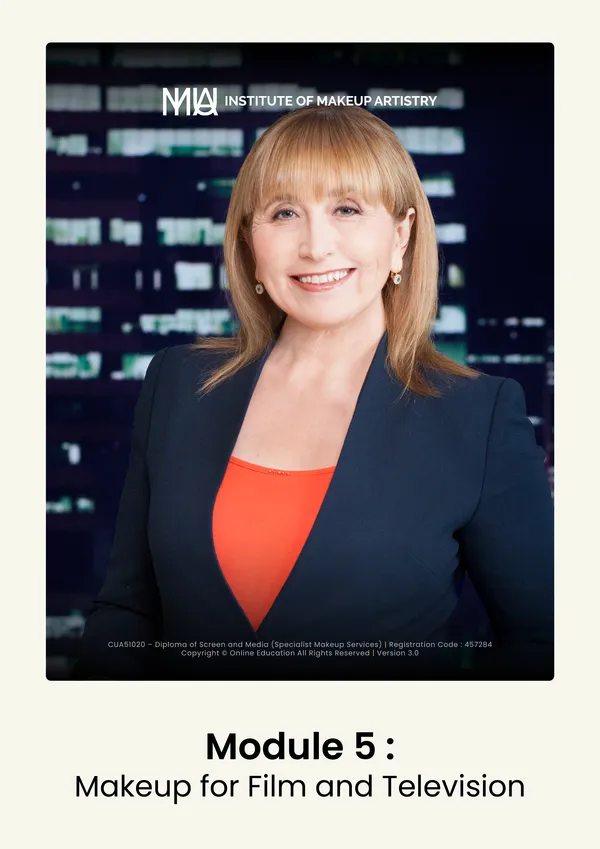 Module 5
Makeup for Film and Television
Summary:
• Lights! Camera! Action! This module introduces you to the exciting world of Film and Television makeup!
• Become familiar with the many industry-specific standards and how they affect makeup design.
• Learn how to apply a news presenter makeup to both men and women!
• Become confident in one of the most crucial elements of film and television makeup – continuity!
Units covered in this module:
Note: This list is not indicative of unit completion, as most of our units are taught (in parts) across most of our modules.
CUAIND512 – Enhance professional practice using creative arts industry knowledge
CUAIND412 – Provide freelance services
CUAMUP411 – Design, apply and remove make-up
CUAMUP412 – Maintain makeup and hair continuity
CUAMUP413 – Style hair for productions
CUAMUP512 – Design and apply specialised make-up
CUADES412 – Interpret and respond to a design brief
CUADES511 – Implement design solutions
Lights! Camera! Action! This module introduces you to the exciting world of Film and Television makeup! Become familiar with the many industry-specific standards and how they affect makeup design. Also learn about one of the most crucial elements of this field, continuity!
- Learning Outcomes Summary
- Units of Competency
- Introduction to Film and Television
- Industry Overview
- Industry Terminology
- Film and Television Framing/Shot Size Definitions
- Film/TV Crews and Their Duties
- Film/Television Crew Members and Their Duties
- Key Creative Team
- Production Department
- Location Department
- Camera Department
- Sound (Audio) Department
- Grip Department
- Electrical Department
- Art Department
- Makeup and Hair Department
- Wardrobe Department
- Post Production
- Visual Effects (VFX)
- Other Production Crew
- Studio Protocol and On Set Expectations
- On Set Procedures and What to Expect
- Professional Conduct
- Professional Image
- Personal Hygiene
- Extra Equipment Required by the Makeup Artist
- Television Makeup
- High-Definition (HD)/Digital Television
- General Rules for HD Television Presenter Makeup
- Floor Duty/On Set Maintenance for Television
- Basic On Set Makeup Kit
- Male News Presenter Makeup
- Makeup for Men
- Excellent Complexion
- Average Complexion
- Problem Complexion
- Other Points to Remember
- Makeup for Excellent Complexion
- Makeup for Average Complexion
- Unusual Problems and How to Fix Them
- Albino Complexion
- Deep Set Eyes
- Pale Lips
- Strong Coloured Lips
- Long Hairs Growing From the Nose, Ears, and Eyebrows
- Chroma Key Compositing/Chroma Keying
- Female News Presenter Makeup
- Applications for Female News Presenters
- Makeup for Female News Presenter
- Film Makeup
- Makeup for Film and the Differences Between Film and Television
- Styles of Film Makeup
- Pre-Production
- Continuity
- No Makeup (or Clean Skin) Makeup Design
- Rushes/Dailies
- ‘No Makeup’ Makeup : Male
- ‘No Makeup’ Makeup : Female
- How to Maintain and Apply Creative Arts Industry Knowledge
- WHS for all Industry Sectors
- Fashion Industry
- Film and Television
- Theatre
- Professional Development and Networking
- Script Continuity Analysis
- Steps to Set up a Continuity System
- Script Analysis : Life is Getting Better
- Continuity Considerations
- Summary of Scenes
- Direct Continuity
- Makeup and Hair Changes for Scene 3
- Character Breakdown Sheets
- Character Breakdown Sheet : Max
- Character Breakdown Sheet : Rebecca
- Character Breakdown Sheet : Sandra
- Example of a Call Sheet From a Different
- Television Series for One Day’s Shoot
- Using 24 Hour Time
- Creating a Roster for the Makeup Department
- Creating a Makeup Budget
- Creating a Makeup Budget for a Production
- Module Exercises
- Assignment 5
Module 6
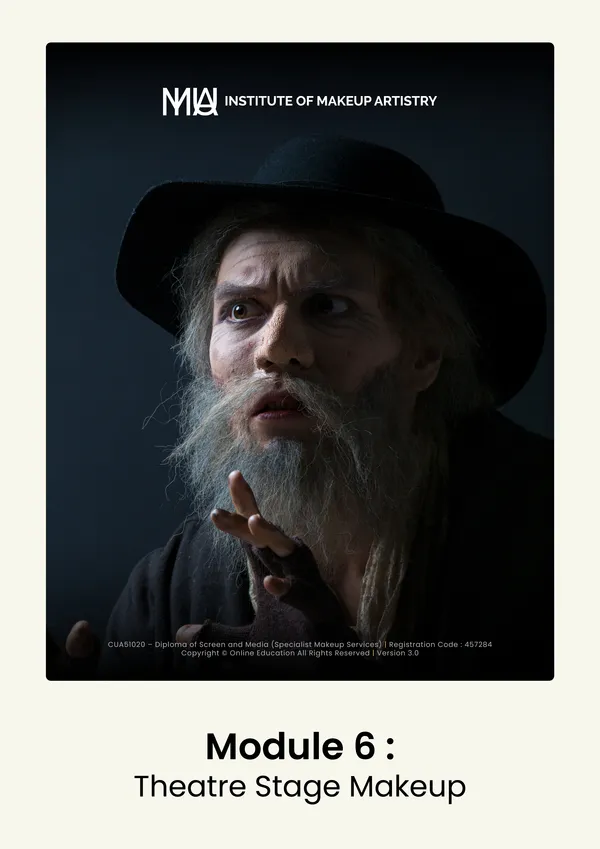 Module 6
Theatre Stage Makeup
Summary:
• This module will take you back in time to provide you with an in-depth insight into the fascinating history of makeup.
• Learn the key differences between makeup for camera and makeup for stage.
• See how to create common theatre characters, like a traditional white-faced clown!
Units covered in this module:
Note: This list is not indicative of unit completion, as most of our units are taught (in parts) across most of our modules.
CUAIND512 – Enhance professional practice using creative arts industry knowledge
CUAIND412 – Provide freelance services
CUAMUP411 – Design, apply and remove make-up
CUAMUP412 – Maintain makeup and hair continuity
CUAMUP413 – Style hair for productions
CUAMUP512 – Design and apply specialised make-up
CUAMUP513 – Design and apply special make-up effects
CUADES412 – Interpret and respond to a design brief
BSBCRT413 – Collaborate in creative processes
CUADES511 – Implement design solutions
As well as teaching you about the key differences between makeup for camera and makeup for stage, this module will take you back in time to provide you with in-depth insight into the fascinating history of makeup!
- Learning Outcomes Summary
- Units of Competency
- Introduction
- Theatre Stage Makeup
- Designing the Makeup
- Lighting and Makeup
- Employment in the Theatre
- Generic Theatrical Makeup Kit
- How to Collaborate in a Creative Process
- After Completion of the Production/Project
- Basic Male Makeup Techniques for Theatre
- Historical Period Makeup
- Period-Based Productions
- Authentic Makeup vs Interpretations
- Ancient Egyptian Period : 3200 BCE (Before Common Era) – 400 CE (Common Era)
- Ancient Roman Period : 753 BCE – 476 CE
- Ancient Greek Period : 800 BCE – 146 CE
- Medieval and Renaissance Periods :
- 476 – 1350 CE (Medieval/Middle Ages),
- 1350 – 1500 CE (Renaissance)
- Tudor and Elizabethan Periods : 1485 – 1558 CE (Tudor), 1558-1603 CE (Elizabethan)
- Stuart and Restoration Periods : 1603 – 1714 CE (Stuart),
- 1660 – 1688 CE (Restoration)
- Georgian Period : 1714 – 1830 CE
- Regency Period : 1811 – 1837 CE
- Victorian Period : 1837 – 1901 CE
- Edwardian and George V Periods : 1901-1910 CE (Edwardian),
- 1910–1920 CE (George V)
- 1920s Period : 1920-1930 CE
- 1930s Period : 1930-1940 CE
- 1940s Period : 1940-1950 CE
- 1950s Period : 1950-1960 CE
- 1960s Period : 1960-1970 CE
- 1970s Period : 1970-1980 CE
- 1980s Period : 1980-1990 CE
- Period Makeup Demonstrations
- Ancient Egyptian Makeup
- Georgian Makeup
- Victorian Makeup
- 1920s Makeup
- 1980s Makeup
- Common Theatrical Characters
- Geisha Makeup
- Hairstyles
- General Technique for Geisha Theatrical Makeup
- Clown Makeup
- The History of Clowns
- Types of Traditional Clowns
- Traditional White-Faced Clown
- Blotting Out / Covering the Eyebrow
- Makeup Removal
- Module Exercises
- Assignment 6
Module 7
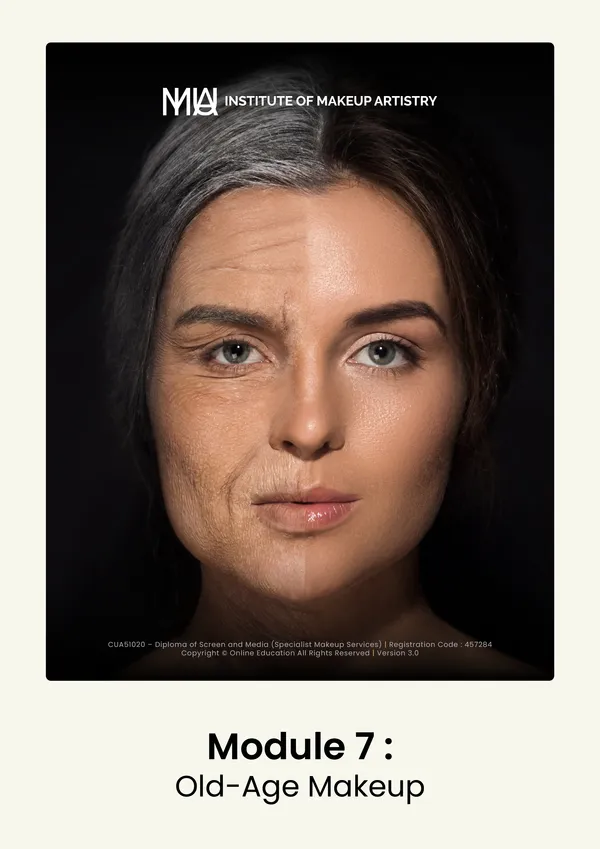 Module 7
Old-Age Makeup
Summary:
• This module is your first taste of Special Effects Makeup, exploring the various techniques available for adding years to a person with makeup!
• Learn how to implement design solutions.
• Become familiar with the topic of copyright.
Units covered in this module:
Note: This list is not indicative of unit completion, as most of our units are taught (in parts) across most of our modules.
CUAIND512 – Enhance professional practice using creative arts industry knowledge
CUAPPR411 – Realise a creative project
CUAMUP411 – Design, apply and remove make-up
CUAMUP512 – Design and apply specialised make-up
CUAMUP513 – Design and apply special make-up effects
BSBCRT413 – Collaborate in creative processes
CUADES511 – Implement design solutions
This module is your first taste of Special Effects Makeup, exploring the various techniques available for adding years to a person with makeup!
- Learning Outcomes Summary
- Units of Competency
- Introduction
- Designing Old-Age Makeup
- Old-Age Characteristics
- Approaches to Aging Makeup
- Highlight and Shade : Approach and Method
- Application Steps for Highlight and Shade Old-Age Makeup
- Removal
- Latex or Stipple : Approach and Method
- Application Steps for Latex or Stipple Makeup
- Removal
- How to Stretch the Skin for Latex and Green Marble Application
- Green Marble : Approach and Method
- Mixing Green Marble Liquid
- Application Steps for Old-Age Makeup Using Green Marble
- Repairs to the Application
- Removal
- Prosthetics : Approach and Method
- Old-Age Makeup Demonstration
- Old-Age Makeup
- How to Implement a Design Solution
- Copyright, Moral Right, and Intellectual Property
- Copyright
- Moral Right
- Intellectual Property
- Module Exercises
- Assignment 7
Module 8
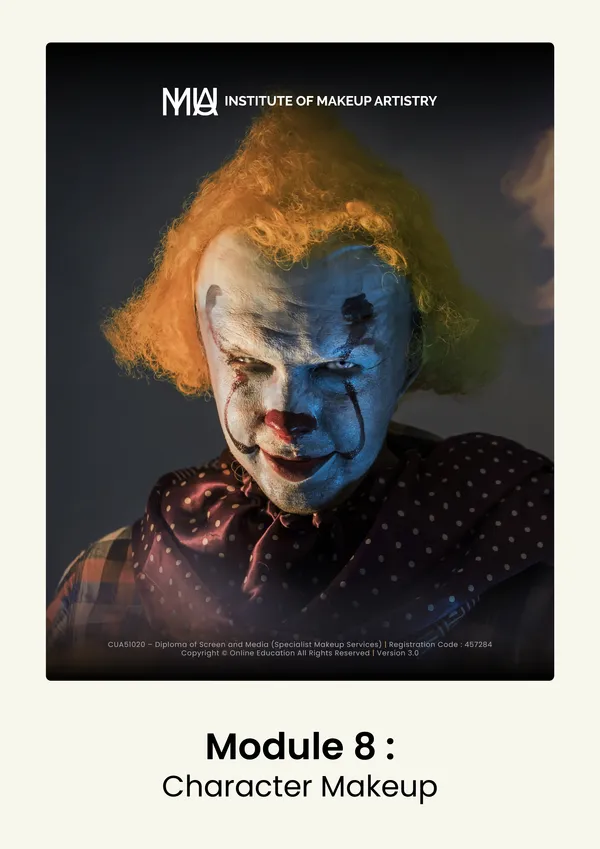 Module 8
Character Makeup
Summary:
• This module will see you delving into the fantastical world of character makeup!
• Learn how to interpret and respond to a design brief.
• Use makeup to create common characters like a traditional witch and Oliver Twist’s “Fagin”!
Units covered in this module:
Note: This list is not indicative of unit completion, as most of our units are taught (in parts) across most of our modules.
CUAIND512 – Enhance professional practice using creative arts industry knowledge
CUAPPR411 – Realise a creative project
CUAMUP411 – Design, apply and remove make-up
CUAMUP512 – Design and apply specialised make-up
CUAMUP513 – Design and apply special make-up effects
CUADES412 – Interpret and respond to a design brief
BSBCRT413 – Collaborate in creative processes
CUADES511 – Implement design solutions
Attain the skills commonly used in the fantastical world of character makeup. This module will have you re-creating your favourite characters in no time!
- Learning Outcomes Summary
- Units of Competency
- Introduction to Character Makeup
- Designing for a Character
- Designing for Film and Television
- Designing for a Character
- Designing for Theatre
- Theatre Makeup Techniques
- How to Interpret and Respond to a Design Brief
- Video Demonstrations
- Witch : Traditional Theatre Makeup
- Scenario : For Design and Production of the Look
- Fagin (Oliver Twist) : Traditional Theatre Makeup
- Scenario : For Design and Production of the Look
- Stage 1 : Crepe Hair Preparation for the Production of a Reusable Wig
- Stage 2 : Application of Bald Cap, Old-Age Makeup, and Foam Latex Prosthetic Nose
- Stage 3 : Application of Crepe Hair and Final Makeup Application
- Module Exercises
- Assignment 8
Module 9
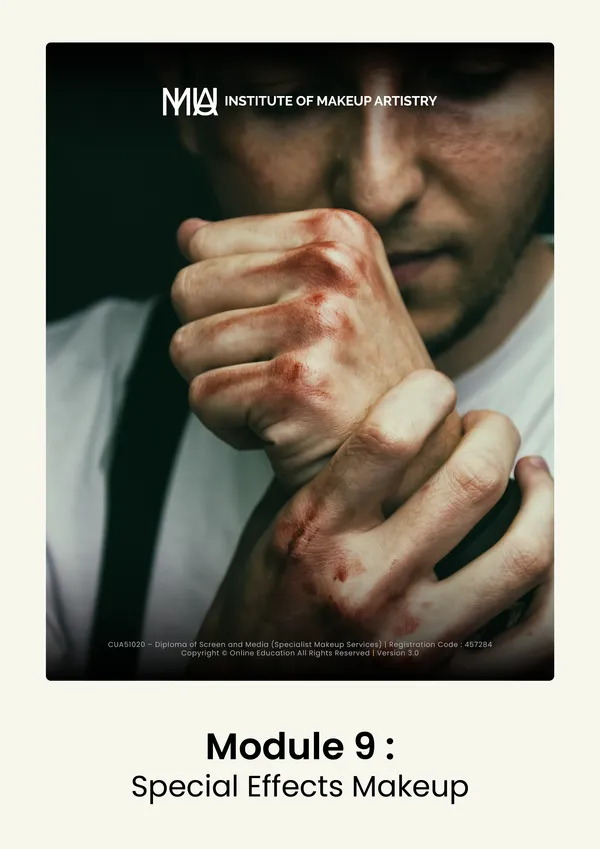 Module 9
Special Effects Makeup
Summary:
• This module officially welcomes you into the attention-grabbing and jaw-dropping world of special effects makeup. With a focus on injury and disease simulation, your creations are sure to give people chills!
Units covered in this module:
Note: This list is not indicative of unit completion, as most of our units are taught (in parts) across most of our modules.
CUAPPR411 – Realise a creative project
CUAMUP411 – Design, apply and remove make-up
CUAMUP512 – Design and apply specialised make-up
CUAMUP513 – Design and apply special make-up effects
CUAMUP614 – Create prosthetics for special makeup effects
CUADES412 – Interpret and respond to a design brief
BSBCRT413 – Collaborate in creative processes
CUADES511 – Implement design solutions
This module officially welcomes you into the attention-grabbing and jaw-dropping world of special effects makeup. With a focus on injury and disease simulation, your creations are sure to give people chills!
- Learning Outcomes Summary
- Units of Competency
- Introduction to SFX Makeup
- What is SFX Makeup?
- An Introduction to Special Effects
- SFX Injury and Disease Simulation
- Bruising : Recreation
- Bruises
- Products Used for Simulating Bruises
- Bruising : Application Technique
- General Technique for Simulating Bruises (for all Mediums : Film, TV and Theatre)
- Working From References
- Abrasions : Recreation
- Products Used for Simulating Abrasions
- Abrasions : Application Techniques
- General Techniques for Simulating Abrasions (for all Mediums)
- Scabs : Recreation
- Products Used for Simulating Scabs
- Scabs : Application Techniques
- General Techniques for Simulating Scabs (for all Mediums)
- Tears and Perspiration : Recreation
- Products Used for Simulating Tears and Perspiration
- Tears and Perspiration : Application Techniques
- General Techniques for Simulating Tears (for all Mediums)
- General Techniques for Simulating Perspiration (for all Mediums)
- Artificial Dirt : Recreation
- Products Used for Simulating Dirt
- Artificial Dirt : Application Techniques
- General Techniques for Simulating Dirt (for all Mediums)
- Cuts and Lacerations : Recreation
- Products Used for Simulating Cuts and Lacerations
- Cuts and Lacerations : Application Techniques
- General Techniques for Simulating Cuts and Lacerations
- Sutures/Stitches : Recreation
- Products Used for Simulating Sutures/Stitches
- Sutures/Stitches : Application Techniques
- General Techniques for Simulating Sutures/Stitches
- Bullet Wounds : Recreation
- Products Used for Simulating Bullet Wounds
- Bullet Wounds : Application Techniques
- General Techniques for Simulating Bullet Wounds
- Bullet Hit Squibs
- Scars : Recreation
- Products Used for Simulating Scars
- Scars : Application Techniques
- General Techniques for Simulating Scars
- Tattoos : Recreation
- Tattoo Styles
- Tattoos : Application Techniques (all Mediums)
- General Techniques for Simulating Tattoos (for all Mediums)
- Chicken Pox (Varicella) : Recreation
- Products Used for Simulating Varicella
- Chicken Pox (Varicella) : Application Technique
- General Techniques for Simulating Varicella (for all Mediums)
- Small Pox : Recreation
- Products Used for Simulating Small Pox
- Small Pox : Application Technique
- General Techniques for Simulating Small Pox (for all Mediums)
- Burns : Recreation
- Varying Degrees of Burn Injuries
- Products Used for Simulating Burns
- Burns : Application Techniques
- General Techniques for Simulating Burns (for all Mediums)
- Injury and Disease SFX for Fantasy Characters
- Creating a Zombie Character
- Products Used for Creating Zombies
- Zombie Character : Application Technique
- General Technique for Creating Zombies (for all Mediums)
- Possible Problems and How to Fix Them
- SFX Film Makeup : Character Contact Lenses
- SFX Makeup Demonstrations
- SFX Film Makeup : Burns Simulation Demonstration
- SFX Film Makeup : Assault Simulation Demonstration
- Module Exercises
- Assignment 9

Module 10
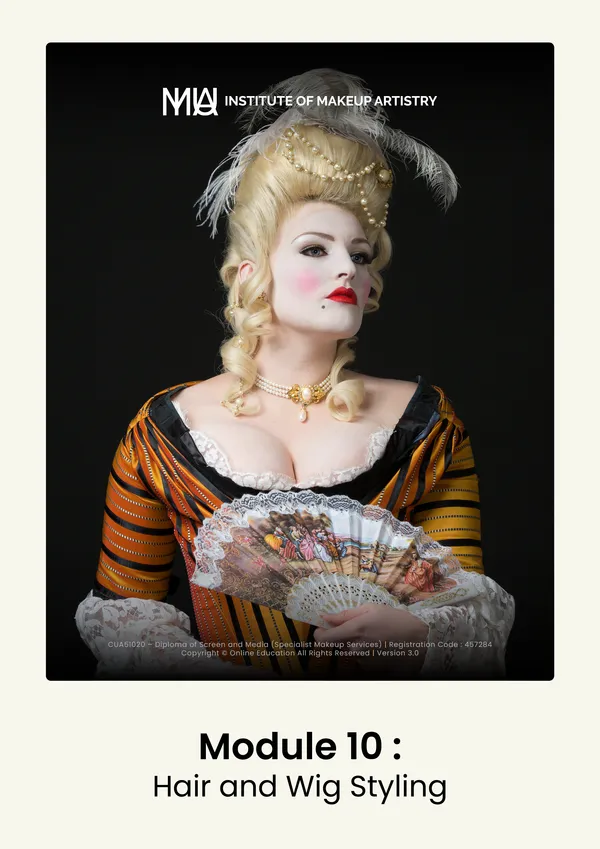
Hair and Wig Styling
Summary:
• This module will introduce you to the world of hair styling and wig application.
• Become familiar with the broad range of hair styling products and equipment available.
• Learn the theory behind hair styling like contouring with hair and identifying common hair ‘problems’ plus how to fix them.
• Learn how to style hair and apply wigs, which are highly sought-after skills for any professional makeup artist, making you stand out from the crowd, especially in the bridal and media industries!
Units covered in this module:
Note: This list is not indicative of unit completion, as most of our units are taught (in parts) across most of our modules.
CUAIND512 – Enhance professional practice using creative arts industry knowledge
CUAMUP412 – Maintain makeup and hair continuity
CUAMUP413 – Style hair for productions
CUAMUP414 – Style wigs and hairpieces for productions
CUAMUP512 – Design and apply specialised make-up
CUADES511 – Implement design solutions
Learn how to style hair and wigs; a highly sought-after skill for any professional makeup artist which will make you stand out from the crowd, especially in the bridal and media industries!
- Learning Outcomes Summary
- Units of Competency
- Style Hair for Performances or Productions
- Introduction
- Work Health and Safety for Hairstyling
- Hairstyling Tools and Products
- Advantages and Disadvantages of Common Hair Products
- Required Skills and Differences Between Hairstyling for the General Public
- and the Media Industries
- Design Elements and Principles
- Design Elements
- Design Principles
- Documenting Hair Designs
- Types of Curls
- Face Shapes and Contouring with Hair
- Contouring with Hair
- Hairstyles for Balancing Facial Features
- How to Resolve Problems with Different Hair Types
- Common Hair Problems and How to Resolve Them
- How to Identify Hair Types
- Basic Characteristics of Each Hair Type
- How to Choose Products for the Different Hair Types
- Hair Growth Patterns
- Common Hair Problems Encountered in the Media Industries
- Popular Products Currently Used in the Professional Industry
- Styling Afro-Textured Hair
- Cultural Sensitivity When Approaching a Client With Afro-Textured Hair
- How to Style Hair
- How to Style Hair
- Newsreader Blow-Dry Bob Style
- Long Wavy Style : Using Curling Tongs
- Contemporary Style : Messy Bun with Side Braid
- Victorian Period Hairstyle
- 1920’s Finger Wave Hairstyle
- Men’s Hairstyle
- Strategies for Maintaining Hairstyles in Challenging Circumstances
- Styles Suitable for Windy and Humid Outdoor Conditions
- Wigs and Artificial Facial Hair
- Wig Types
- Comparisons of Synthetic Fibre and Human Hair
- Suggested Wig Suppliers
- Measuring a Client
- How to Measure a Client for a Handmade Natural Hair Wig
- Preparing a Client
- Preparing a Client for Wig Application
- Pin Curls
- Hair Wrap (no clip for this section)
- Wig Preparation and Care
- Wig Blocking : Non-Lace Front, Synthetic Wig
- How to Block a Non-Lace Front, Synthetic Wig
- Tools Used for Blocking a Synthetic Wig
- Technique for Blocking a Synthetic Wig
- Wig Blocking : Lace Front, Human Hair Wig
- How to Block a Lace Front Wig
- Tools Used for Blocking a Lace Front Wig
- Technique for Blocking a Lace Front Wig
- Wig Trimming : All Types
- Tools Used for Trimming Wigs
- Steps for Trimming a Wig
- Wig Cleaning : Non-Lace Front, Synthetic Wigs
- Hygiene Protocols
- Products/Tools for Cleaning a Synthetic Wig
- Steps for Cleaning a Synthetic Wig
- Wig Cleaning : Lace Front, Human Hair Wig
- Products/Tools for Cleaning a Lace Front, Human Hair Wig
- Steps for Cleaning a Lace Front, Human Hair Wig
- Wig Storage
- Synthetic Wigs
- Human Hair Wigs
- Wig Application
- Application of a Medium- and High-
- Grade Wig : Synthetic (Regular Front)
- Application of a Lace Front Wig Synthetic or Natural Hair
- Wig Styling
- Introduction
- Styling Synthetic Wigs
- Styling Human Hair Wigs
- Resolving Potential Wig Problems
- Wig Styling Example : Lace Front, Synthetic Wig Styling
- Apply a False Moustache
- Apply a Artificial Hand Knotted Moustache
- Module Exercises
- Assignment 10
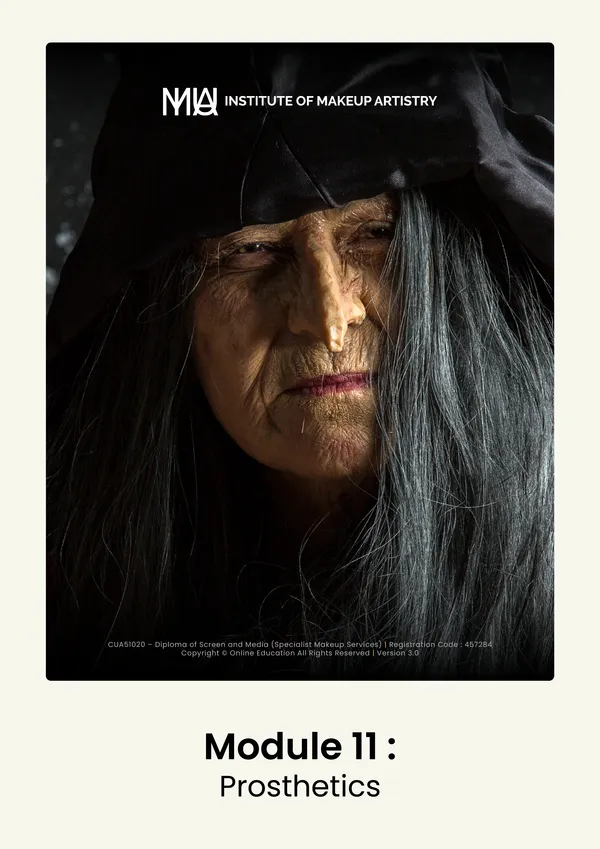
Module 11
Prosthetics
Summary:
• A deeper look into special effects makeup, this module will take you the world of special effects prosthetics!
• Learn how to originate and develop concepts.
• Gain the skills required for creating simple out-of-kit prosthetics as well as more advanced prosthetics, like a partial ‘face cast’!
Units covered in this module:
Note: This list is not indicative of unit completion, as most of our units are taught (in parts) across most of our modules.
CUAIND512 – Enhance professional practice using creative arts industry knowledge
CUAPPR515 – Establish and maintain safe creative practice
CUAPPR411 – Realise a creative project
CUAMUP512 – Design and apply specialised make-up
CUAMUP513 – Design and apply special make-up effects
CUAMUP614 – Create prosthetics for special makeup effects
CUADES412 – Interpret and respond to a design brief
CUADES511 – Implement design solutions
A final look into the depths of special effects makeup, this module will give you the skills required for creating simple prosthetics!
- Learning Outcomes Summary
- Units of Competency
- Introduction
- History of Prosthetic Makeup
- The Modern SFX Makeup Artist
- How to Originate and Develop Concepts
- How to Originate and Develop Concepts
- How to Develop Creative thinking
- Visual Creativity
- Mind Mapping
- How to Make a Presentation
- Further Considerations for Designing and Applying Specialised Makeup
- Prosthetics Take SFX Makeup to the Next Level
- SFX Makeup Enhances Characterisation
- How to Evaluate Finished Prosthetics Against Production Requirements
- for Improvement
- Prosthetic Manufacture Techniques
- Simple Prosthetic Techniques
- Out-of-Kit Prosthetic for Theatre
- Create Your Own Scar Plate
- Scar Plate Technique
- Prosthetic Manufacture Using a Partial Face Cast
- Stage 1 : Take an Impression of the Model’s Nose
- Stage 2 : Create a Plaster Copy/Cast of the Model’s Nose
- Stage 3 : Create Nose Bump Number One Using Clay Sculpting
- Stage 4 : Create a Mould for Nose Bump Number One
- Stage 5 : Create the Latex Prosthetic for Nose Bump Number One
- Stage 6 : Create Nose Bump Number Two
- Stage 7 : Apply Nose Bump Number One and Complete the Makeup
- Stage 8 : Apply Nose Bump Number Two
- Advanced Prosthetic Manufacture Techniques
- Introduction
- Full-Face Cast & Plaster Mould for Foam Latex Prosthetic Appliance
- Stage 1 : Create a Plaster Life Cast (Full Face Cast/Mould of the Face)
- Stage 2 : Create the Plaster Cast (Copy of the Model’s Face)
- Glossary
- Foam Latex
- Alternative Technique : Urethane Mould & Encapsulated Silicone
- Prosthetic Appliance
- Alternative Technique : Additional Information
- Airbrushing
- Alternative Technique : Epoxy Resin
- Recent Innovation in Prosthetic Manufacture : 3D Printing
- Advantages of 3D Printed Prosthetics
- Examples of Productions Where These Prosthetics Were Used
- Examples of SFX Makeup Artists who use this Technology
- Module Exercises
- Assignment 11
Module 12
 Module 12
Working as a Freelance MUA
Summary:
• The refining touch to your newly acquired skills can be found in this module, which will equip you with the knowledge required to put your skills into professional use!
Units covered in this module:
Note: This list is not indicative of unit completion, as most of our units are taught (in parts) across most of our modules.
CUAIND512 – Enhance professional practice using creative arts industry knowledge
CUAIND412 – Provide freelance services
CUAPPR411 – Realise a creative project
CUAMUP513 – Design and apply special make-up effects
BSBESB402 – Establish legal and risk management requirements of new business ventures
CUADES412 – Interpret and respond to a design brief
BSBCRT413 – Collaborate in creative processes
The refining touch to your newly acquired skills, this module will equip you with the knowledge required to put your skills into professional use!
- Learning Outcomes Summary
- Units of Competency
- Introduction
- Establishing a Successful Makeup Business
- Setting up Your Business
- Business Name
- Checklist for the Development & Maintenance of an
- Effective Financial & Documents Records System
- Insurance
- Requirements for Working From a Business Premises and Employing
- Workers in Australia
- How to Get Clients
- Professional Conduct
- Networking
- Branding and Marketing
- Portfolio
- MUA Branding Example
- Resume
- Cover Letters
- Business Card
- Website
- Social Media
- Checklist for Establishing a Makeup Artistry Business
- Tips for Working in Specific Industry Sectors
- Wedding
- How to Create a Work Agreement for Client Bookings
- How Timing is Calculated
- What if the Details of my Booking Change?
- Makeup ‘Touch up’ Maintenance Kit
- Cancellation Policy
- Cancellations Due to Government Restrictions
- Permission to Publish Images on Social Media
- Points to Note
- Client Feedback Form
- Wedding Makeup Service Risk Factors & How to Manage Them
- Considerations for Attending a Hotel Room to Provide a Makeup Artistry Service
- Fashion
- Film
- Television
- Theatre
- Working as an MUA Assistant
- How to Negotiate Contract or Agreement Variations When Working as a Freelance MUA
- How to Create a Contract with a Supplier of Goods or Services for Your
- New Business
- How to Review Your Work Objectives Measured Against Quality of Life,
- Artistic & Commercial Goals
- Commercial Goals
- Artistic Goals
- Quality of Life
- Congratulations
- Module Exercises
- Assignment 12