
Introduction
You’ve spent years behind the lens. You’ve hardly spent any time strategizing on how you’d like your work to be seen by others. Does that sound like your photography education? A photography portfolio is much more than just a lovely portfolio of your photographs. It is, rather, a business plan for your artistic work. It tells your prospective client, employer, or admissions committee who you are as a photographer and what you’re able to bring to the table.
The earlier you take steps in order to develop one in a strategic way, the sooner you’ll take flight in your photography career. Below are 5 steps all photography students ought to take in order to make their portfolio achieve their desires.
Master The Technical Fundamentals First
You can’t curate what you can’t shoot! Depth of field – Works with the aperture on your camera to decide how much of your photo is in focus.
Your portfolio must show you know exactly what you’re doing. So, here are the 11 technical photography skills you must master:
Camera Settings You Must Master
- Aperture: Affects your depth of field and the buttery quality of your bokeh. Open the f/1.4 for a subject completely separated from the background; go narrow to an f/11 for a fully focused frame.
- Shutter Speed: Whether you want to freeze the moment in time (e.g., burst mode at 1/1000s) or blur it creatively (e.g., long exposure of city lights for 30 seconds), this is how you control it.
- ISO: Controls your sensor sensitivity. Higher settings are great for low-light conditions but may introduce noise or “grain” that can be used as an aesthetic or simply a mistake, depending on execution.
- White Balance: Your camera’s eye: this sets the color temperature to make sure your skin tones, shadows, and highlights look like what the human eye is used to seeing.
Composition and Lens Control
- Depth of Field: Works in tandem with aperture, controlling how much of your image is in focus. This can transition you from a razor-sharp subject with a painterly background to an entirely focused scene.
- Exposure Compensation: You know when your camera doesn’t quite get the brightness of an image correct? It’s a high-contrast environment: that’s where exposure compensation comes in.
- Focal Length: Dictates the field of view. A 35mm focal length feels quite natural for many people, an 85mm is universally flattering for portraits, and a 24mm distorts reality, adding visual interest.
Advanced Photography Techniques
- Luminosity: The overall tonal range of an image, how your shadows, mid-tones, and highlights are balanced in your final edited file.
- Long Exposure: More of a creative challenge than technical, a long exposure requires a tripod, patience, and a deep understanding of the passage of light, often creating an entirely new world.
- Lighting: Natural, artificial, or a mix: Understanding how the light falls, where it’s coming from, and how you can shape it is key. This can make or break a photo.
Practice Makes Professional
Mastering these technical photography skills doesn’t happen overnight. Every professional photographer develops these fundamentals through consistent practice, real-world assignments, and constructive feedback. Learning how these concepts are taught in a professional photography program can give you a clearer roadmap for building a portfolio that attracts clients, internships, and job opportunities.
Choose a Genre and Commit to It
Let’s be real: probably the biggest mistake that student photographers make is to consider their portfolio their own personal scrapbook, shoving in a mixture of portraits, landscapes, street, food, and event pictures all together. On the one hand, I get it. You want to show versatility. But for anyone viewing your work professionally, it just looks all over the place.
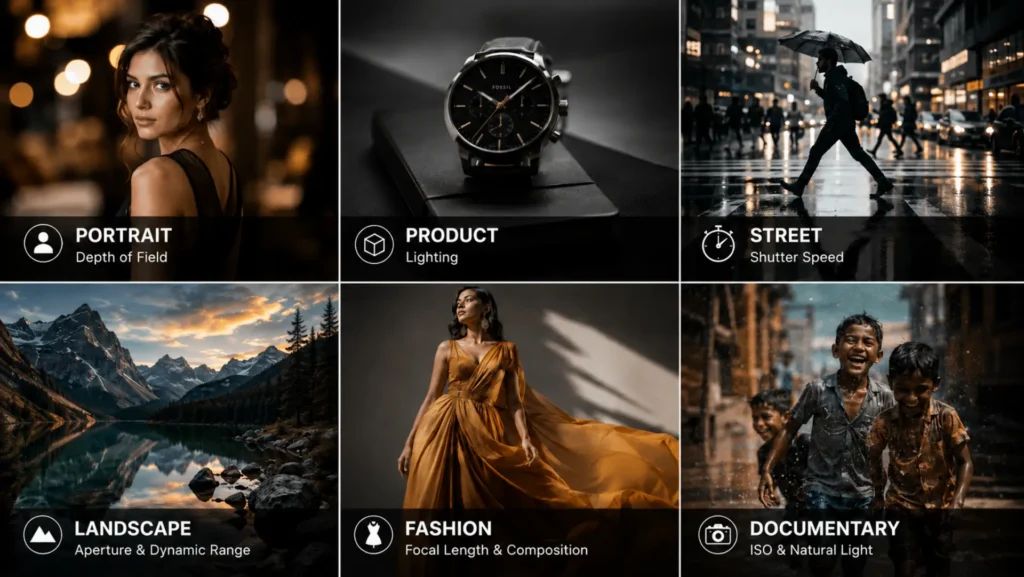
Choosing a niche isn’t confining yourself. It’s concentrating. Specializing in one photography genre helps you develop a distinct visual language. It also allows you to work more systematically with light and composition. You can make informed decisions about aspect ratio, framing, and post-production for every shot.
A portrait photographer who understands natural window light can create more compelling images. They can also create a sparkle in the subject’s eyes and use depth of field to draw attention to the subject. This combination helps tell a much stronger story. This approach is often more impactful than creating thirty photographs across ten different genres.
Several photography genres are highly sought after. These include commercial and product photography, portrait and editorial photography, fashion photography, and documentary photography. Each genre is technically different and requires a unique set of skills.
Product photography demands a strong understanding of white balance and the ability to work confidently with studio lighting. Fashion photography, on the other hand, requires knowledge of focal lengths and how different lenses can enhance or distort the human form. Whatever you choose, work on going in-depth before you go broad.
Shoot Real Projects, Not Just Practice Frames
You can instantly spot the difference between an image captured during practice and one created for a real client brief. Clients and potential employers can spot the difference too. The reason is not always better equipment. It is the higher stakes, clear intent, and real-world constraints that shape the final image.
What most students don’t realize is that there are opportunities for actual gigs!
- You could offer to photograph a product launch for a local business.
- You could photograph a friend’s band’s album release.
- You could photograph a production at a local college.
- You could document a local community event.
The bottom line is that all of these are real briefs: You will have a subject, a deliverable, a deadline, and a paying client.
When you begin to photograph these jobs, you’ll learn to adapt to various lighting situations, select an appropriate aspect ratio before you even raise your camera to your eye, maintain consistent white balance and exposure compensation, and direct subjects if needed for a specific brief. Adding these images to your portfolio is evidence that you are not just capable of taking a decent photograph but also that you understand the demands of the real professional world.
Edit with a Consistent Visual Voice
We all hear that we need a solid portfolio. Well, guess what? Your editing is every bit as important as the pictures themselves! Just think about it: two photographers could shoot the exact same shot, with the exact same settings, on the exact same camera and have wildly different results when they get into editing. And that’s style! And style (when you use it consistently) will quickly become the foundation of your signature style as a photographer.
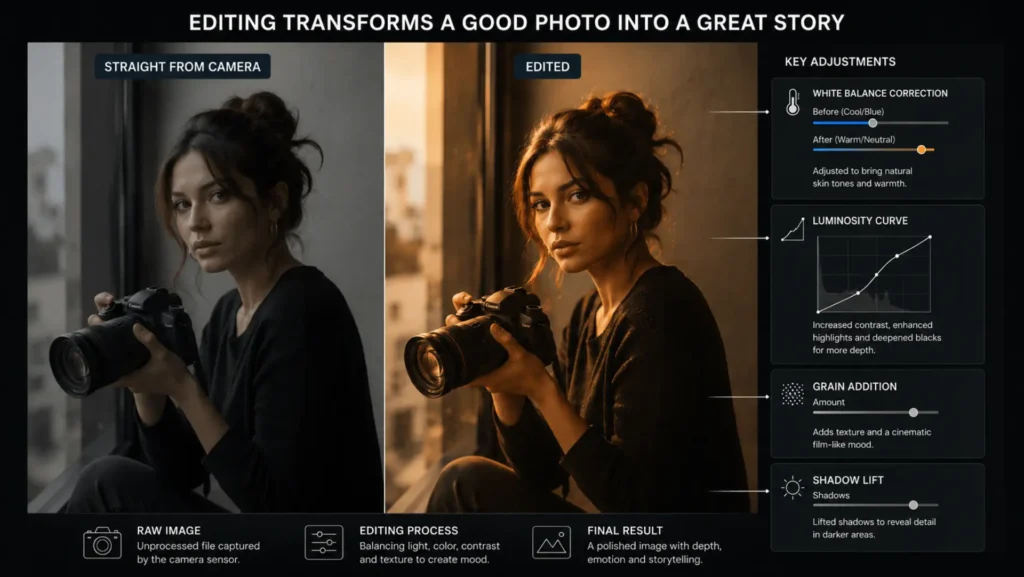
- So how do you create that editing voice? By being really deliberate about the decisions you’re making on the following in all of your photos:
- Luminosity: Is your tonal range on the lighter, airy side? Or is it darker and more grounded?
- Grain Properly utilized, it’s a rich, film-like, or even lithographic look. Misused, and it’s just noise.
- Color Temperature What is your white balance? Warm and commercial or cool and editorial?
- Contrast & Shadow Detail Are you lifting your shadows? Or crushing your blacks and going for that more dramatic, cinematic look?
There isn’t a single “correct” editing style in photography, but consistency is what separates a memorable portfolio from an average one. If every image has a different color palette, contrast, or editing approach, it becomes difficult to recognize your creative identity. Developing a consistent visual style using tools like Adobe Lightroom or Capture One helps establish your personal brand and makes your portfolio more cohesive. As your skills grow through advanced photography projects and formal education, maintaining a recognizable editing style becomes an essential part of professional portfolio development.
For students considering a long-term career in photography, understanding how a Bachelor’s Degree in Photography develops technical, creative, and post-production skills can provide valuable insight into building a portfolio that reflects a distinct visual identity.
Curate Ruthlessly and Present Professionally
This is where most student portfolios fail not because the images are weak, but because they’re too numerous or because they’re arranged in a way that weakens their overall impact. Curating your portfolio takes confidence. It says, “I know which of my images are strong enough to represent me, and I’m not filling it up with other pictures.”
A working portfolio generally has between 15 and 20 images. Each picture should earn its place. If you find yourself questioning if a picture should be included, then it shouldn’t. The best portfolios feature only images that make you stop and say, “Wow.”
- SEQUENCE is king: start strong and end strong, and vary the pacing in between
- Make sure your images are in the same orientation or build a layout that handles multiple orientations in an elegant way
- Include technical details if they will add value to the assignment, the lighting setup, and your intention.
- Make sure your bio is brief and to the point: who you are, what you shoot, and what you’re looking for.
You need to have a dedicated portfolio website. Your Instagram isn’t your portfolio; it’s your social media feed, and it’s treated as such. A website puts you in control of sequencing, spacing, aspect ratios, and context. That’s where you include a short artist statement, contact details, and project notes that explain the technical aspects of your work and its results.
If you’re applying for a position in fine art, fashion, or editorial photography, a physical portfolio will be more meaningful. The quality of your prints, paper, and binding all convey how much you value a photograph’s physical manifestation. Invest in at least one quality printed presentation of your 10 best images.
FAQ
Portfolio Basics
A strong photography portfolio should typically include 15–20 of your best images. Quality is always more important than quantity. Every photograph should demonstrate your technical skills, creativity, consistency, and unique style. Whether you’re applying for internships, freelance projects, or a photography course in Mumbai, a well-curated portfolio creates a lasting first impression.
No. You don’t need high-end equipment to create an impressive photography portfolio. Understanding composition, lighting, storytelling, and camera settings matters far more than owning expensive gear. Many successful photographers began with entry-level cameras and developed their skills through consistent practice and professional guidance.
It’s best to build your photography portfolio around one primary genre, such as fashion photography, commercial photography, portrait photography, wildlife photography, or product photography. Specializing helps showcase your expertise and makes your portfolio more attractive to employers, agencies, and clients looking for specific photography skills.
Digital Portfolio & Career Tips
Instagram is a great platform for sharing your work, but it should not replace a dedicated photography portfolio website. A personal portfolio website allows you to organize your projects professionally, control the viewing experience, improve your online visibility through SEO, and present your work in a way that reflects your personal brand.
At Le Mark Institute, portfolio development is an essential part of every photography course. Students gain access to professional photography studios, real-world industry assignments, expert faculty guidance, portfolio review sessions, and creative projects that help them build a job-ready portfolio suitable for internships, higher education, freelance opportunities, and professional photography careers.
Yes. While digital portfolios are essential, a printed photography portfolio remains valuable for interviews, client meetings, gallery submissions, fashion photography, editorial photography, and fine art photography. A professionally printed portfolio demonstrates attention to detail and leaves a memorable impression during in-person presentations.
Conclusion
So, how do you build your portfolio as a student? It’s not about filling it with lots of pictures or the fanciest camera. It’s about making intentional technical, creative, and editorial choices and showcasing them in a way that tells a coherent story of you as a photographer. Start with the basics, shoot in real life, find your editing voice, and select honestly.
If you’re seeking a place where you can create all this from scratch, Le Mark Institute offers UG degrees, diplomas, and professional certificate courses in photography. Each program includes industry exposure and portfolio-building support. That’s how you get training that equips you for the real world and not just the shoot.