
Introduction
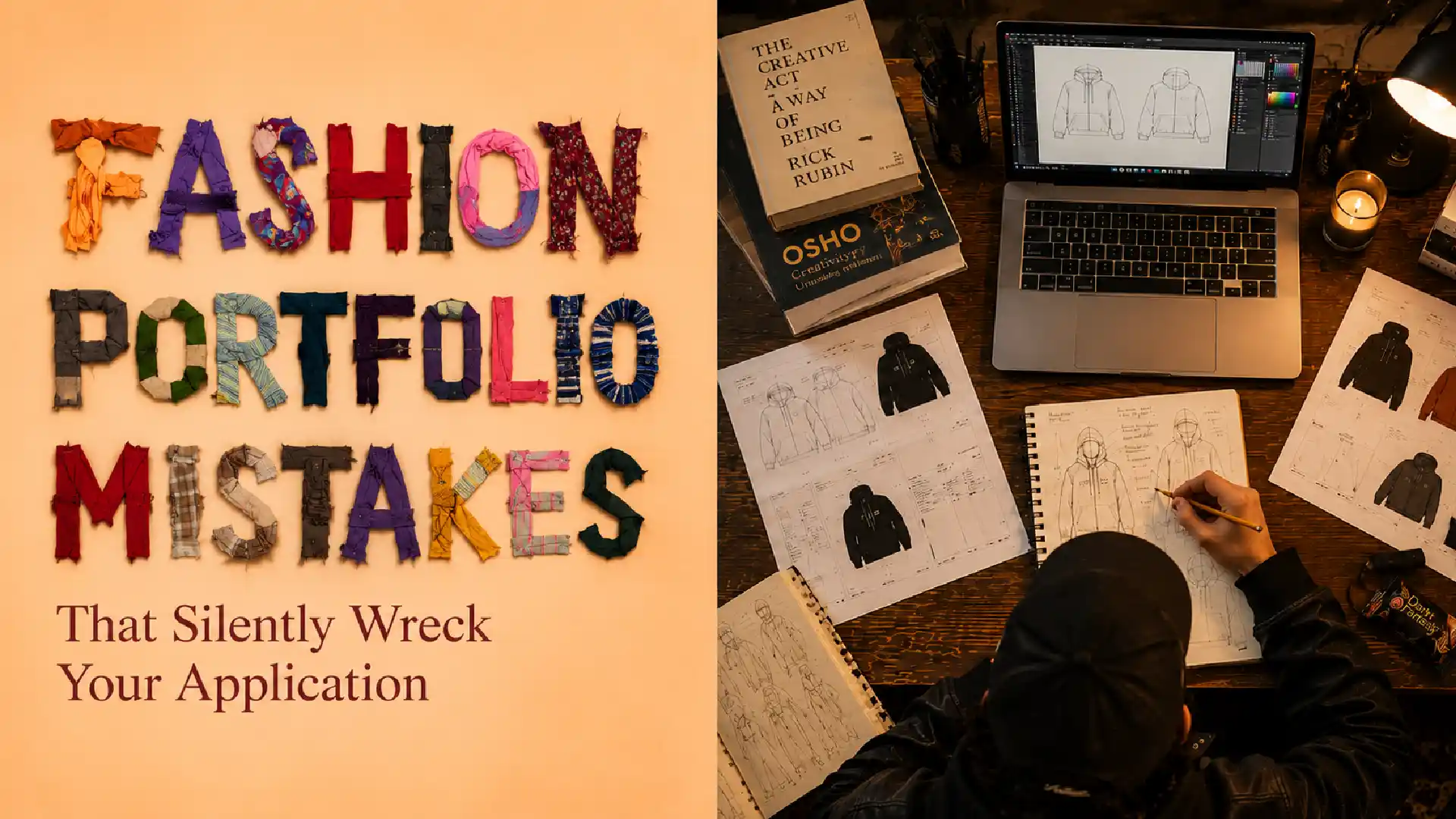
Every fashion student has the notion that they have perfectly conveyed the story they want to tell in their fashion portfolio. Most of the time, however, recruiters and admissions officers who are reviewing brand presentations think otherwise. There’s often a disconnect between how fashion students see their portfolios should look to impress admissions committees and hiring managers with the neatest final products, the demonstration of all possible skills, and as much paper as possible versus how the industry actually wants their presentations to be.
That disconnect is bigger than you might think. Here are five common missteps you might be inadvertently making, including placing too much value on process sketches and confusing breadth with range, and how to fix them.
#1 Ignoring the Creative Process
The Mistake: Your fashion portfolio should contain only completed work.
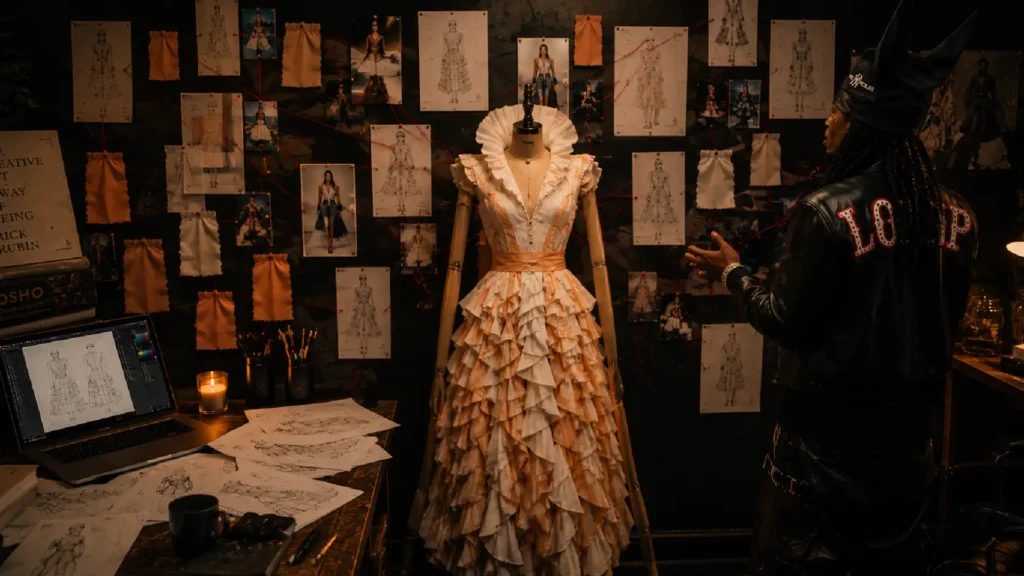
The Reality: The research, iteration, and failed ideas of a finished product can’t tell a story of the design thinking that went into creating it. Japanese designer Kiro Hirata (of the Kapital label) likens his creative process more to assembling a puzzle, with pieces and ideas fitting together until they create the final product, rather than begin with a finished final product in mind.
And that process-first attitude? It’s precisely what a good portfolio should reflect how you work, not just what you create.
Fix it:
- Tell the story of document iterations (not just the final product). This includes your sketches, your toile, your fabric samples, etc.
- Retain the ideas that don’t make the cut. Add these to your portfolio. You can include a justification for why it wasn’t right for the final project.
- Share the “why” of your finished project with as much clarity as the project itself.
#2 No Personal Style or Identity
The Mistake: You need a portfolio that highlights each and every one of your unique skillsets and stylistic choices.
The Reality: Your unique point of view shines much brighter than a smattering of diversity ever will.
For instance, Jun Takahashi, the founder of the legendary cult brand Undercover, has openly discussed his major inspiration isn’t necessarily a style but a point of view on anti-conformity, staying true to his subversive viewpoint no matter what the trends happen to be. It’s an ethos that bleeds through his collection of work, as opposed to a specific silhouette restated year after year.
Fix it:
- Choose two or three motifs or themes and reinforce them intentionally throughout your portfolio.
- Strip out everything that doesn’t support your specific vision, no matter how skillfully rendered it might be.
- A reviewer should be able to sum up your aesthetic in a single sentence after scrolling through the first 10 pages.
#3 The Impact of Colour Usage
The Mistake: Bright, trend-driven color automatically makes your project shine.
The Reality: conscious and deliberate color narrative stands far more strongly than trend-chasing.
I heard Virgil Abloh use an analogy once: imagine showing off a candle in an art gallery as opposed to showing it in a garage. The same thing can seem and feel entirely different, based on how and where you present it. Color plays into that presentation. It’s a narrative medium that strengthens, rather than unintentionally undermines, your project’s story.
Fix it:
- Create a color palette for each project based on its theme (rather than seasonal trends).
- Test to make sure colors will look appropriate in both digital and print portfolios.
- Determine if your colors are telling a story or just dressing up the text.
#4 One-Size-Fits-All Portfolio
The Mistake: Your standard portfolio works for any brand or school.
The Reality: tailoring your pieces and order to your audience makes a world of difference. This is especially true at Jean Paul Gaultier where the house now asks a new guest designer to revisit its codes each haute couture season.
This fall, when Sacai’s Chitose Abe took the helm, she spent weeks with the archive, prior to putting one stitch, so that she would know what codes to borrow, and what to stitch on top of with her own stamp.
Her finished product, therefore, wasn’t merely a Gaultier impression nor a fully expressed Sacai, but rather a hybrid constructed for house, season, and guest.
Fix it:
- Look into the school or brand’s identity and style before deciding to make your choice.
- Reorder pieces so that whatever you decide is most relevant to the person you’re reviewing first.
- Remember if the judges value concept, commercial wearability or both, because rarely do these two concepts line up.
#5 Quantity Over Curation
The Mistake: more is better, more means more talented.
The Reality: a well edited portfolio of just 10-12 pieces works far better than a massive one.
Michael Stewart is an Irish designer that has founded his entire business, Standing Ground, on this – he would rather release 1-2 impeccably finished products a year for the sake of quality, than mass produced work just to satisfy a rail. It took him less than 10 years from RCA graduate to presenting his collection at Paris haute couture.
Fix it:
- Remove anything that’s just “good enough”; strip everything back down to your very best only.
- You’ll find it surprisingly difficult to do yourself, so ask a tutor/mentor if you need objective feedback on which pieces are your strongest.
- Don’t include something in your work just to bulk out your page numbers – if it doesn’t deserve to be there, it shouldn’t be included.
Student Portfolio vs. Industry-Ready Portfolio
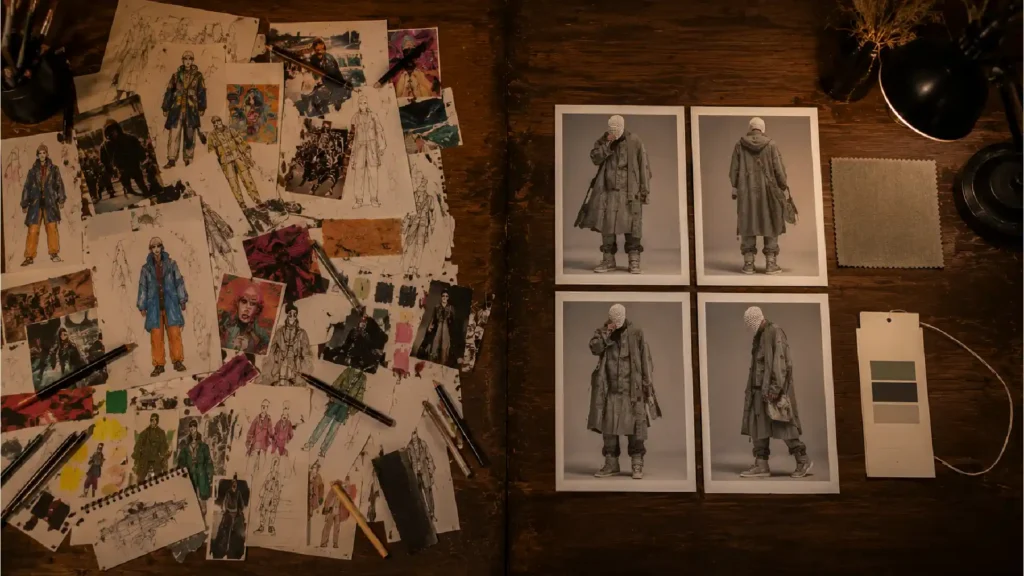
The pair is not the same piece of work, and that is where a large number of applicants trip up – seeing them as interchangeable. Central Saint Martins tutors on its BA Fashion course have been frank: wearability is not the primary concern of their course, they argue; the market is already bursting with commercial products. Instead, they encourage the students to move into conceptual and process-led designs; the ones which might not just end up on the high street.
The logic is different in the industry.
Menswear designer Robyn Lynch uses every discussion with a buyer as a design research tool – the commercial sale is as much an important aspect of inspiration gathering over a number of months of library time, just like looking at archives. And Paula Canova del Vas, a Central Saint Martins MA graduate, explained that she got her stockists straight after graduating, not knowing what a linesheet was nor how to price an item the commercially minded skill set that the school does not teach.
FAQs
Most reviewers respond best to 10–12 tightly curated pieces rather than a bloated collection. Quality of thinking beats quantity of pages every time.
A student portfolio is judged mainly on concept and process; an industry-ready portfolio adds commercial judgment, price point, wearability, and a cohesive, sellable range.
Color should tell a story specific to each project’s concept rather than chase a passing trend; reviewers notice the difference immediately.
Yes. Research the reviewer’s aesthetic and values first, then reorder or reselect pieces to lead with whatever’s most relevant to them.
Not strictly, but structured mentorship like Le Mark’s Fashion Design course helps translate raw talent into a portfolio that reads clearly to admissions panels and industry recruiters alike.
Conclusion
Smashing these five mistakes and the creative examples of designers such as Hirata, Takahashi, Abloh, Abe, and Stewart, who are each the antithesis of what I’ve described above, will only take you so far. Taking the knowledge and building an application-ready portfolio requires supported practice, and that’s where a course such as Le Mark’s Fashion Design programme comes in, constructing the documentation of process, the creation of individual style, and the development of market understanding from day one.